
Showing posts with label hypothesis. Show all posts

Review of The Science of God

In reference to: Testimony of Former Young Earth Creationist
That is a long and thoughtful intellectual trip, more effort expended than I had anticipated when Ed introduced himself to the group. On that occasion I sent to him (direct) a short note, but to date I have had no response.

Edward: “To date” (from the posting of my “intellectual journey” to your reply above) is less than 27 hours. Time must rush by at a furious pace for you. I can imagine you standing on your porch waiting for a reply the day after you mailed someone a letter (in ye old snail-mail days). Well, Iʼm here now, and you may ask me anything either in this forum or at my home or work email. My work email is ed.babinski@ and I may be contacted there 9:30AM-6:00PM M-F, but again, with work, there are no promises how soon I can reply.


I duplicate it for CED(below) and trust that he has completed all the research necessary for a reply.
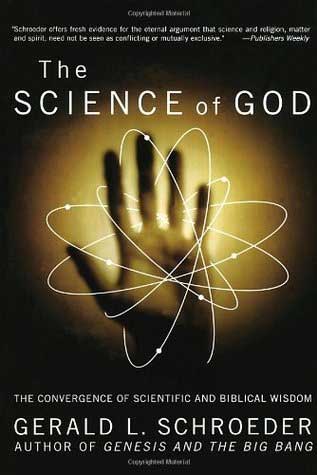
Review of The Science of God

Edward: You “trust” that I have “completed all the research necessary for a reply.” Not very trustful it would seem. Thatʼs understandable. I hope that you have read as widely as I have, and examined each question in as many ways and from as many angles as I have, though I lack absolute “trust” that that is so. Itʼs not really a matter of trust at this early point of discussion, but of the trickiness inherent in all communication about complex, wide ranging, deeply believed, controversial subjects. On the topics of biological origins and the Bible much has been written, and I doubt both of us have read exactly the same articles, books. So, right from the start our ideas about certain subjects are not going to coincide. Perhaps agreement about many of those subjects will prove impossible without a fairly large number of books, articles, sources of information, that we both hold in common. Even so…the chorus goes, what “ELSE” have you read about this, that, and the other? (In the end, life is short and so is time for study. And for those two reasons I cannot imagine a “God” who condemns people to hell after they have been blown to and fro in this world for a mere couple of decades in a raging sea of ideas and emotions.)

I also think knowing more about you might aid future communications. (Your e-name isnʼt a cover for “Phil” Johnson is it?). What has your “intellectual journey” been like? I find most peopleʼs stories interesting, having read many testimonies of people who have entered and/or exited various religions/philosophies.


Dear Ed, Welcome.

Edward: Thanks! Happy to be here…Happy to be anywhere in fact.


You seem to have developed a strong preference for a position.

Edward: I have a strong preference for asking questions (and researching questions. My research projects led to a job at a university library — no I am not a full librarian). I have found various attempts at “concordance” questionable. I found the Bibleʼs creation story(s) questionable. And Iʼve found I.D. hypotheses also questionable. At the moment my question for I.D.ers is simply this, “If there is a Designer, what can we learn about their level of say, competency, by examining various aspects of nature and natureʼs history? A Divine Tinkerer perhaps?” Personally, I am open to theism, even a personal God, personal beings of light, etc. But I do not have any proof, mainly anecdotes, like NDEs. And the Bible no longer constitutes proof of anything to me concerning its cosmology and cosmogony. The way I presently see things, it is relatively easy to explain the origins of ancient Hebrew creation stories and motifs, while an explanation for how things evolved is more difficult.


So, let me start with two questions. 1) What do you think is important about Darwinism,

Edward: I donʼt think in those terms. I have explained my position in my “intellectual journey” and above.


and 2) what type of evidence do you consider most important in validating Darwinʼs theory?
Phil

Edward: I have no sacredly held theories of my own, neither Darwinism nor I.D. I have questions. I have read atheists/naturalists and what they have said about nature. I have read I.D. hypotheses and critiques of those hypotheses. I have read young-earth creationism and critques of young-earth creaitonism. I have read old-earth creationists and theistic evolutionists. I have read concordist and non-concordist arguments. I have studied and compared ancient near eastern cosmologies and cosmogonies, and also read attempts to make Genesis (chapters 1 -3) appear to be the first and last word on origins.


For concordance of Bible and Science I suggest books by scientist Gerald L. Schroeder(our library has three).

Edward: I find Schroederʼs “concordances” more of a demonstration of Schroederʼs agility of mind than “proof” of the truth of the Bible. In fact, Schroederʼs central concordance, that both the Bible and modern science agree there was a “beginning,” ignores the fact that other creation stories agree there was a “beginning” and also agree with Genesis concerning many “less than scientific” matters that Schroeder ignores or attempts to interpret away.

Schroederʼs claim about how much genetic change it would take to create human beings is wrong. According to the latest data, “The difference between human and chimp genomes is only about 1.23%, rather than 1.4% as originally thought.”
Even more importantly, modern day chimps and man diverged so the differences that accumulated in each of their TWO genomes over time is greater than the differences between either ONE of them and their common ancestor, which would be less than 1.4% In fact even the present day differences between human and chimp genomes are less than that between the genomes of near identical sibling species of fruit flies. And there is even evidence INSIDE human chromosome #2 that points to it being the result of the fusion of two chromosomes that very closely resemble those found in the chimp which line up band for band to those in manʼs chromosome #2.

Here are some reviews of Schroederʼs books I found on the web that reflect my own questions. I sorted the reviews so they would begin with simpler criticisms and build to more elaborate ones by professors of zoology and physics. It is apparent that Schroederʼs “Kabbalistic” concordance hypothesis pleases neither young nor old-earth creationists and their readings of Genesis:

A young-earth creationist Amazon reviewer of The Science of God:

“I find many of his interpretations manipulated to his own cause, e.g. Gen. 1:12 which he interprets: “and the earth brought forth life.” A more reliable interpretation of the text renders: “and the earth(or land) brought forth vegetation.” Further, he cites no credible Hebrew scholar who agrees with his interpretation of day for order and night for chaos. He relies much more for his case on the mystical kabbalah, especially Nahmanides, which can only be explained at best as “opinion.” This leaves him in positions which do not square with all of inspired Scripture…For the exact opposite view of Schroederʼs key thesis: clocks ticking faster at the center and slow at the edge of the cosmos— see young-earth creationist, D. Russell Humphreysʼs book “Starlight and Time.”

Old earth creationist Hugh Ross reviews Schroederʼs Genesis And The Big Bang:
Source: www.reasons.org/

“One problem with his view is that it clashes with the scientific data on the timing of Earthʼs origin. Since the earth already exists on the first creation day of Genesis 1, Schroederʼs model would say that Earth began at least 12 billion years ago. Scientific measurements, however, show that it is only 4.6 billion years old.
Our view is that Genesis 1:2 establishes the frame of reference for the creation events: “The Spirit of God was brooding (or hovering) over the surface of the waters.” In other words, Godʼs time and space frame in describing creation is the earthʼs surface, a frame in common with all readers of the account. The text gives no hint of Schroederʼs relativistically time-extended creation days. If one seeks Jewish support for a day-age interpretation of Genesis 1, Nathan Aviezer, another Jewish physicist, offers it in a book entitled In the Beginning: Biblical Creation and Science (Hoboken, NJ: KTAV Publishing House, 1990). Aviezer acknowledges that the six creation days of Genesis 1 must refer to long time periods.”

Amazon Reviewer of The Science of God: seapapa from Los Angeles

“Schroederʼs thesis is that the author of Genesis is describing a 15 billion year history of the universe and life, even though that was never his understanding or his intention. The true meaning Genesis 1 went undetected until it was discovered by the cabalist author Nahmanides in the 11th Century AD. It was lost again until Schroeder rediscovered it.

“Even accepting the dubious proposition that people can write things that actually mean the exact opposite of what they intend, the match between the Genesis timeline and the scientifically proposed history of the universe makes an ill fit. Schroeder tries to reconcile the two by focusing minutely on certain words in Genesis that could be interpreted to allow for longer time periods, while totally ignoring the text read in its entirety. For example, day three of creation supposedly lasts 1.6-3.6 billion years ago. Genesis said “let the land produce vegetation”. Success, proclaims Schroeder, that matches the plant life on the planet, which is found only in the… water! He conveniently ignores the rest of the verse which calls for fruit-bearing trees and seed-bearing plants. There was nothing but protozoa and plankton back then. This is typical of the book.

“The most absurd argument is that, if properly interpreted, the 6 creation days correspond to 6 actual 24 hour days on earth AND 15 billion cosmic years. How so? Einsteinʼs relativity of time! Schroeder makes such an effort to preserve the 6 days of creation and the order of creation.

“This book is ultimately a polemic. Although brilliant and articulate, one gets the feeling that Schroeder cannot bear to have Genesis undermined. That compromises his scientific judgment.”

A Reviewer of The Science of God (at amazon.com):

“contains a few good passages, but also some egregious errors, which are puzzling when made by a PhD in Physics. For example, G. Schroeder completely misinterprets the experiments with particles moving through openings, invents some odd concept of heat diluting in enlarged volumes, misrepresents the story of photoelectric effect, etc. One striking feature of this book is that Schroeder suggests in it the chronological data , which completely contradict his own data on the same subject, given in his first book, without a word of explanation why he changed those data. A useless book.”

A Reviewer of The Science of God (at amazon.com) wrote:

“His time dilation calculations are totally at fault. The factor of one million million he uses is totally arbitrary (nothing really special happened at z=1 million million). His redshift/blueshift calculations are also wrong: The background temperature (and the redshift) changed by less than 10% in the last billion years. Nowhere near the rate needed to slow down from a 500 million year per day (Day 5, according to Schroeder) to 24 hours per day.

“Another serious mistake appears in his coverage of evolution: He says the the evolution from chimpanzees to humans requires a million point mutations because the difference in the active DNA between human and chimps is 1,000,000 bases.

“This is simply false. Schroeder himself says that the number of changes needed is no more than 70,000. In most cases a single point mutation is enough to complete a change.

“It would have been better if Schroeder, as a nuclear physicist, asked an expert biologist before writing his chapters about evolution…”

Frank Sonleitner,Department of Zoology, University of Oklahoma, Norman OK 73019 reviews Schroederʼs The Science of God:
Source: www.ncseweb.org/

“This book is essentially an elaboration and update of Schroederʼs earlier book Genesis and the Big Bang published in 1990. Schroeder is an Israeli physicist who has also extensively studied biblical interpretation. He uses the arguments of the Anthropic principle (the Big Bang and the fine-tuning of the universal constants) as evidence for God; but he also insists that the Bible and science agree. Genesis is not to be taken literally nor dismissed as poetry but must be interpreted correctly following the lead of talmudic scholars such as Nahmanides and Maimonides. Although his interpretation twists, stretches, and sometimes directly contradicts the literal meaning of Genesis, it confirms all the findings of modern cosmology and geology.

“Using a universal time clock based on the stretching of the wavelengths of light as the universe expands, he concludes that the universe is 15.75 billion years old. The six days of Genesis consist of a nonlinear day-age description of the history; day 1 covers the first 8 billion years, and day 6 only the last 1/4 billion.

“Schroeder accepts the standard geologic and paleontologic history of the earth but he balks at evolution (although he admits some sort of genetic continuity as suggested by the evidence of comparative anatomy, biochemistry and embryonic recapitulation). He rejects all transitional forms among higher categories such as classes and phyla, but later admits that there might be transitional forms within classes. (He does discuss the recently discovered intermediate forms of whales.)

“Schroeder rejects evolution because he considers its mechanism to rest solely on pure chance. There is no discussion of natural selection; it doesnʼt appear in the index although the term is used in passing while discussing Dawkins. His “proof” that it is impossible for convergent evolution to produce similar eyes in taxa which did not inherit these structures from a common ancestor uses a mathematical calculation based on two assumptions - (1) evolution is pure chance; and (2) the taxa have no genes in common except those “inherited” from the protozoa. Yet in other places he seems to be aware of the recent evidence that the phyla have many genes in common; he discusses the Hox genes that determine body plans and the Pax genes that are involved in eye formation!

“Schroeder admits that there were “pre-Adamites” (Cro-Magnon and Neanderthals) living for 40 000 years prior to Adam, but questions the existence of earlier hominid species because of the fragmentary nature of their fossils. Again he uses a mathematical model to show that the evolution of humans from an ape ancestor is impossible. This model also assumes that (1) evolution would occur by pure chance and (2) one million mutations would be necessary to produce the ape-human transition!

“It takes more than the Big Bang and the fine tuning of universal constants to demonstrate that the creator is the kind, loving, personal God worshipped by Christians. And there Schroederʼs arguments fall apart. For example, he argues that quantum mechanics provides the basis of free will and that the determinacy of our genes does not prevent our exercising free will, yet later he says that randomness in nature (including random mutations) is necessary for free will! And natural disasters are necessary. We must suffer earthquakes and volcanic eruptions that result from plate tectonics made possible by the earthʼs molten core because the latter is necessary to generate a magnetic field to protect us from the high energy radiation produced by the life-giving sun. But then he says that the biblical Creator could have made stars that didnʼt produce those lethal rays but “they would not be natural” and would offer absolute testimony of the Creatorʼs existence! And still later he contradicts this principle (that the universe is organized “naturally” to hide the existence of the Creator) by saying that the earth is at an “unnatural” distance from the sun and hints that this may be miraculous! (According to Schroeder some exponential law determines the distance of the planets, and the earthʼs distance does not fit the pattern.)

“Evolutionists will justifiably criticize Schroeder for his simplistic and inconsistent treatment of evolution while the real creationists will reject him for his theology which includes rejection of the literal reading of Genesis, acceptance of the Big Bang, an old age for the earth, existence of pre-Adamites, a local flood, and ignoring Christ, Christianity and the New Testament.”

Victor J. Stenger, professor of physics and astronomy at the University of Hawaii and the author of Not By Design: The Origin of the Universe (Prometheus Books, 1988), Physics and Psychics: The Search for a World Beyond the Senses (Prometheus Books, 1990), The Unconscious Quantum: Metaphysics in Modern Physics and Cosmology (Prometheus Books, 1995) and Timeless Reality : Symmetry, Simplicity, and Multiple Universes (Prometheus Books, 2000), Review of Schroederʼs The Science of God.

“How can both the Bible and science be right? Israeli physicist Gerald Schroeder says he can show us how. Letʼs start with cosmology. The Bible says God created the universe in six days and indicates the passage of only about 6,000 years since then. Science currently estimates the visible universe to be about 13 billion years old, give or take a few billion. Schroeder reconciles the two, explaining that the six days of the Bible refer to a different measure of time. He explains: “there is no possible way for those first six days to have an Earth-based perspective simply because for the first two of those six days there was no Earth” (51).

“Instead, time during this six day period was measured on a cosmic clock. And what else could be used for that clock but the vibrations of light (electromagnetic waves)? Today the light from creation appears as the cosmic microwave background. This is now redshifted by a factor of a trillion (1012) from the period of “quark confinement” when matter as we know it first began to form. Thus the cosmic clock at that epoch ran off a trillion days for each of our modern days.
The six cosmic days of creation thus took about 15 billion years earth time, give or take a few billion. So, according to the author, Genesis is not only consistent with cosmology, it gives the correct age of the universe!

“Each of the six days in Schroederʼs Genesis actually takes a different length of earth time. The duration D, in earth days, of each cosmic day t is calculated from the formula D = (Ao/L)exp(-Lt), where Ao = 4x10¹² (the ratio of the frequencies of the cosmic microwave background at quark confinement compared to now) and L = 0.693 (natural log of 2). More simply, cosmic day one is 8 billion earth years long and you divide by two to get the duration of each succeeding cosmic day.

“Cosmic day one starts 15.75 billion earth years ago and covers the creation of the universe, the “breaking free” of light as electrons bind to atomic nuclei, and the beginning of galaxy formation. This is described in Gen. 1:1-5 as the creation followed by light separating from the darkness.

“Cosmic day two starts 7.75 billion earth years ago and lasts four billion earth years. During this period the stars and galaxies are born. This corresponds to Gen. 1:6-8, the formation of the heavenly firmament.

“Cosmic day three starts 3.75 billion earth years ago. During two billion earth years, the earth cools, water appears, and the first life forms appear. In Gen. 1:9-13, vegetation first appears during the third day.

“Cosmic day four starts 1.75 billion earth years ago and lasts a billion earth years. The earthʼs atmosphere becomes transparent and photosynthesis produces an oxygen-rich atmosphere. Schroeder says that this corresponds to Gen. 1:14-19 when “the Sun, Moon, and stars become visible in the heavens” (67).

“Cosmic day five starts 750 million earth years ago and lasts 500 million earth years. During this period, the first multicellular animals appear and the oceans swarm with life. Gen. 1:20-23 says the waters bring forth swarms of living creatures and “birds fly above the earth” (94).

“Cosmic day six starts 250 million years ago and ends at the time of Adam. During this period we have a massive extinction in which 90 percent of life is destroyed and then repopulated with humanoids and humans. This, Schroeder says, corresponds to what is described in Gen. 1:24-31.

“Technically, Schroederʼs formula gives the present as the end of the sixth day. However, it could just as well have ended a few thousand years ago and not affect the rest of the calculation where things are rounded off at hundreds of millions of years. Schroeder argues that after the six cosmic days of creation, Genesis switches its focus over to humanity and starts measuring time in human terms. The rest of the Bible concerns itself with the 6,000 earth years since Adam and Eve, estimated from the Bible in Bishop Ussher fashion.

“Schroeder does not deny the existence of hominid creatures before Adam. He talks about Neanderthals and Cro-Magnons, and accepts that they had developed tools, pottery, and many human-like qualities. In Lev. 11:33 the Bible talks about pottery. But, Schroeder argues that since it never mentions the invention of pottery, that event must have pre-dated Adam (130).

“According to the author, the Bible has no interest in these pre-Adam hominids because they were not yet fully human and had no souls. Thus they are never mentioned. Adam represents the quantitative change to a large brain, but more important, the qualitative change that makes us different from all other forms of life: “our soul of human spirituality” (133). God breathed this into Adam, the first real human, 6,000 years ago.

“Schroederʼs attempt to connect 31 lines of Genesis to big-bang cosmology and earth paleontology makes entertaining reading, but will convince no one who is not already convinced or totally lacking of critical facilities.

“Let us return to the beginning. Schroederʼs use of quark confinement as the defining moment for his cosmic time scale is completely arbitrary. He seems to have chosen it for no better reason than it gives the answer he wants. The redshift from quark confinement to the present is of the order of 1012. Multiplying this by six days gives 15 billion years, which is consistent with our current estimate for the age of the universe.

“Alternatively, Schroeder might have chosen the moment in the early universe called “decoupling,” which represents the point where radiation separates from matter. Indeed, he relates this event to the separation of the “light from the darkness” described in Genesis day one. But the redshift from decoupling to the present is only of the order of 1,000, which would give an earth time interval of only fifteen years for the six cosmic days of creation. If he had chosen some other moment, he would have obtained yet a different time scale.

“Furthermore, by Schroederʼs own formula the universe creation corresponds to the time of quark confinement. Blueshifting back from that point rather than redshifting ahead, the events prior to quark confinement would recede infinitely into the past, in earth time, and we would have no creation at all.

“Schroederʼs use of an exponential function to give different earth periods for each cosmic day is not justified by his argument that earth time is simply redshifted cosmic time. While an exponential relationship would apply for the inflationary epoch in the early universe, that has ended by the time of quark confinement. Afterwards we have the almost linear Hubble expansion in which the redshift varies as a power law with time, not exponentially. By having each cosmic day half as long as the preceding one in earth years, again a completely arbitrary, unjustified procedure, Schroeder is able to vaguely relate events known from cosmology to those described in Genesis.

“In cosmic day two the “firmament” is created. Note that Schroeder excludes from the “firmament” all galaxies more than 7.75 billion light years away, of which there are many. Furthermore, he sees no problem with calling the expanding universe a “firmament.” Like all apologists, he selects his data carefully, accepting only those which agree with his hypotheses and discarding those which do not.

“Primitive life first appears in cosmic day three. Here again it takes some mighty stretching to associate what is described in the Bible for the third day, including fruit trees, with the primitive life described by paleontology for that epoch.

“Schroeder has the sun, moon, and stars becoming visible in cosmic day four. In fact, Genesis seems to say the that sun, moon, and stars are created at that time - well after the earth was created.

“Cosmic day five has the waters teeming with life. But the biblical verses imply birds as well. Schroeder says that “birds” is a mistranslation and that the Bible here is referring to water insects instead. Translation is so easy when you know what you want a passage to say.

“Cosmic day six contains the mass extinctions of life that occurred 65 million years ago. The biblical verses referenced make no mention of mass extinction. The Biblical Flood occurs well after Adam, but Schroeder needs to end the six days of creation with Adam for other purposes. This is one event he simply cannot make fit, although he is not honest enough to say so and leaves the impression that everything is consistent.

“At times you get the impression that this book is a parody, with quite a few good chuckles when read in that context. However, the sections on evolution soon convince you that no parody is intended. They are just too unfunny, too dull. Schroeder trots out all the old, tiresome arguments about why “life could not have stared by chance” and how the simplest forms, even viruses, are “far too complex to have originated without there being an inherent chemical property of molecular self-organization and/or reaction enhancing catalysts at every step of their development” (85). He applies the usual creationist deception of calculating chance probabilities as if chance is the only operative mechanism, and then saying this “proves” that God intervenes along the way when they come out very low. And, of course, the “staccato aspect of the fossil record” refutes classical evolution. “These rapid changes cannot be explained by purely random mutations at the molecular-genetic level” (87).

“Notice how often theists tell us that something cannot be explained except by God? They never seem to learn from history.”

Revised Title: The Delusions of Gerald Schroeder, December 5, 1997
Reviewer: from St. Louis, Missouri
I was intrigued by the title, but agitated by the contents. The entire book is filled with completely preposterous assumptions and conclusions. After reading such a book, I begin to question why someone, such as Gerald Schroeder, view themselves as scientists.


For an improved perspective on the contributions from Paleontology I repeat what I sent recently to DM: Henry Gee, Editor of Nature, in his “Deep Time”, recognizes all Paleo is ‘scenario elaboration’ synthesized from fragments and the proponentʼs worldview, beyond the reach of experimentation, not encumbered by the testable predictions on which science depends. Phil(a scientist)

Edward: What level of “elaboration” was the editor of Nature speaking about?

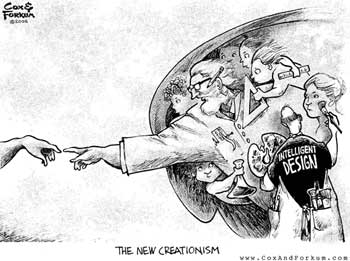
Intelligent Designer or Tinkerer?

Intelligent Designer or Tinkerer?

In the beginning, or, rather, before the Big Bang, the Designer fine-tuned six cosmological constants. But that merely resulted in heating and lighting vast realms of lifeless space, and created a cosmos with colliding galaxies, exploding stars, quasars emitting dangerous radiation, black holes sucking star systems into oblivion, meteors, asteroids and comets pounding the life out of whole planets - in other words, a universe coming to death blows with itself, imperiling any life that may arise in it.

If you are an “Intelligent Design” proponent who accepts the earth is ancient, then you must also accept that the Designer used all his care, wisdom and power to design millions of creatures that arose at precise times over periods of hundreds of millions of years. But He didnʼt use that same care and wisdom and power to spare his little darlings from falling asteroids, glaciations, volcanic eruptions, earthquakes, droughts, floods, storms, viruses, bacteria, parasites, and the fangs and claws of their fellows. In fact, the Designer utterly destroyed species after species in five great extinctions, not to mention many lesser extinctions that mark the end of nearly every period in the geologic record. Also, as Malthus and Darwin pointed out, some animals lay tens of thousands of eggs and some plants produce tens of thousands of seeds. Relatively few survive. They are born only to die.

Nor did this Designer get things right the first time. He has had to keep tinkering with creatures over periods of millions of years. He tinkered with reptiles in order to produce synapsids, “mammal-like” reptiles with double jaw joints; then tinkered with those synapsids to produce true mammals by shrinking the second jaw joint until it became an inner ear bone. Such a transition can be traced in the fossil record.

He also tinkered with feathered dinosaurs until he had a few that could fly, but not very well, since the earliest ones all retained reptilian features that hindered their ability to fly, like the lack of a large keel bone to anchor large flying muscles. They also had teeth and long bony tails. So early flying reptiles were heavier, making it more difficult to fly. Their skulls were still triangular and thick like in reptiles, instead of smooth, light and helmet-shaped like modern birds. Their long bony tails added drag, and their wrist bones were not fused, which limited maneuverability and steadiness in flight. So, the Designer tinkered with the first feathered fliers every few million years, until he designed better ones. No evidence here that such a Designer was perfect or could get it right the first time. Again, why did the Designer have to tinker with monkeys for millions of years, then tinker with larger brained primates for millions more, before producing “man?”

Iʼd say the “Intelligent Design hypothesis” should be renamed, the “Tinkerer hypothesis.” For all we know this Tinkerer may have even fiddled with creating more than one cosmos which was incapable of sustaining life before discovering the right “cosmological constants” that could produce a cosmos capable of sustaining life as precariously as ourʼs does. Of course the hypothesis that “cosmological constants were tinkered with before our cosmos was born” is impossible for us to verify or deny. But the “Tinkerer hypothesis” seems to fit what we do know about the cosmos and life on earth after the Big Bang, and for that reason, it has more to recommend it than the “Design hypothesis.” [B. and Kenneth E. Nahigian]

Suppose that upon some island we should find a man a million years of age, and suppose we found him living in an elegant mansion, and he should inform us that he lived in that house for five hundred thousand years before he thought of putting on a roof, and that he but recently invented windows and doors; would we say that from the beginning he had been an infinitely accomplished and scientific architect? [Robert Ingersoll]

Some ID-ers believe in a Designer who instantaneously created different plants and animals and plopped them down at different points in geologic time. This means that a vast multitude of animals and plants were created only to suffer pain and death over periods of millions of years and then have their species become extinct. “Designing” creatures for pain, suffering and extinction, and then having to “design” some more for that same “purpose,” was repeated again and again, all before man arrived on the scene.

At least in an evolutionary scheme, no animal or plant arises just for the “purpose” of going extinct, but so that it may play a part in the ever branching struggle to occupy new niches and continue the evolution of life on earth. Thus, evolution allows theists to make more sense out of millions of years of animal life, death and extinction, than the “Intelligent Design hypothesis” does. - B.

“How do you explain the beauty and harmony of nature?”

Answer: “Throughout the animal kingdom, animals prey upon each other or die of hunger (or nature kills them in a myriad other ways). For my part, I am unable to see any great beauty or harmony in the tapeworm. Let it not be said that this creature is sent as a punishment for our sins, for it is more prevalent among animals than among humans. I suppose the questioner is thinking of such things as the beauty of the starry heavens. But one should remember that stars every now and again explode…” [Bertrand Russell, “What Is an Agnostic?”]

How can one speak about the “mercy and goodness” of a nature in which so many animals devour animals, where so many mouths are slaughter-houses and stomachs are tombs? “Observe,” said the minister to his son, “the beneficent design with which the crane is fashioned - legs, bill, and feet - to catch fish with ease and be fed.” “Yes,” replied the boy, “I think I see the beneficence of God, at least so far as the crane is concerned, but donʼt you think the arrangement a little hard on the fish?” [E. M. Mcdonald, Design Argument Fallacies]

A butcher-bird impaling its victim on a thorn, or a lion killing a gazelle, or a cat biting a mouse, or a tick feeding on the eye of a fowl, or an intestinal worm eating in the entrails of a priest are all part of the “divine plan” which theists say exists. [Woolsey Teller]

Can we find “design” in the fact that even in every drop of every sea is a battlefield in which the strong devours the weak? [Robert Ingersoll]

People who believe in “intelligent design” point us to the sunshine, to flowers, to the April rain, and to all there is of beauty and of use in the world. Did it ever occur to them that a cancer is as beautiful in its development as is the reddest rose? That what they are pleased to call the adaptation of means to ends, is as apparent in the cancer as in the April rain? By what ingenious methods the blood is poisoned so that the cancer shall have food! By what wonderful contrivances the entire system of man is made to pay tribute to this divine and charming cancer! What beautiful colors it presents! Seen through a microscope it is a miracle of order and beauty. All the ingenuity of man cannot stop its growth. Think of the amount of thought it must have required to invent a way by which the life of one man might be given to produce one cancer. Is it possible to look upon it and doubt that there is a design in the universe, and that the inventor of this wonderful cancer must be infinitely powerful, ingenious and good? [Robert Ingersoll]

The cosmos is a gigantic fly-wheel making 10,000 revolutions a minute. Man is a sick fly taking a dizzy ride on it. Religion is the theory that the wheel was designed and set spinning to give him the ride. [H. L. Mencken]

We are all naturally like that madman at Athens, who fancied that all the ships were his that came into the Port of Pyraeus. Nor is our folly less extravagant. We believe all things in nature have been designed for our use. Ask any theologian why there is such a prodigious number of stars when a far lesser number would perform the service they do us, and he answers coldly, “They were made to please our sight.”
[Bernard de Fontenelle, A Plurality of Worlds, published in 1686]

Was the Universe Made for Man or Flea?

Until the 1800s almost everyone had fleas and lice. In the 1600s it was considered bad manners to take lice, fleas or other vermin from your body and crack them between your fingernails in company.
[Tim Woods and Ian Dicks, What They Donʼt Teach You About History]

Obviously only a Designer would have had the infinite wisdom and compassion to create “the flea” - a tiny insect with a thin body for moving easily through hair, and with immensely powerful legs for leaping many times their body length onto passing prey; and with the added ability to not just harry and bite, but to spread infections, including plague germs which killed tens of millions of people in Europe and Asia in a few short years. [B.]

My dear fleas, you are the cherished work of God; and this entire universe has been made for you. God created man only to serve as your food, the sun only to light your way, the stars only to please your sight, etc.
[Voltaire, “Sermon Preached Before Fleas”]

Can anyone really think itʼs all there just for us? A goldfish in a bowl has as much right to imagine the galaxy was built for it. [Kenneth E. Nahigian]
It took billion of years to prepare the cosmos and billions more to prepare the earth for man, impatient as the Creator doubtless was to see him and admire him. Civilized man has been here maybe less than 32,000 years. If the Eiffel Tower were now representing the worldʼs age, the skin of the paint on the pinnacle-knob at its summit would represent manʼs share of that age; and anybody would perceive that that skin was what the tower was built for.
[Mark Twain, “Was the World Made For Man?”]

Are we really so splendid as to justify such a long prologue? The philosophers lay stress on values: they say that we think certain things good, and that since these things are good, we must be very good to think them so. But this is a circular argument. A being with other values might think ours so atrocious as to be proof that we were inspired by Satan. Is there not something a trifle absurd in the spectacle of human beings holding a mirror before themselves, and thinking what they behold so excellent as to prove that a Cosmic Purpose must have been aiming at it all along? Why, in any case, this glorification of Man? How about lions and tigers? They destroy fewer animal or human lives than we do, and they are much more beautiful than we are. How about ants? They manage the Corporate State much better than any Fascist. Would not a world of nightingales and larks and deer be better than our human world of cruelty and injustice and war? The believers in Cosmic Purpose make much of our supposed intelligence but their writings make one doubt it. If I were granted omnipotence, and millions of years to experiment in, I should not think Man much to boast of as the final result of all my efforts.
[Bertrand Russell, “Cosmic Purpose” in Religion and Science]

Weʼre just a virus with shoes.
[comedian Bill Hicks, CD, Rant in E-Minor]

Thereʼs these Christian fundamentalists, the ones who are trying to get creationism taught in school as a science. I think it would be great because it would definitely be the shortest class of the day. “Welcome to creationist science. In the beginning God created the heavens and the earth. On the seventh day he rested. See ya at the final!” - Bill Hicks (comedian)

I believe in equal time for creation science. But since creation only took six days and evolution took billions of years, the equivalent time spent teaching creationism should be six seconds for every twelve years of evolutionary science.
- Skip Church, _The Damned Say the Damndest Things_

ftom24: when God created all was Good and right, no collisions, no death, none of what we see today…but thatʼs a subject for another board….

Edward Babinski: Well, if youʼre going to ignore modern geology and respond to what I wrote with a totally unevidenced theological defence that the world was originally “perfect” with “no death, none of what we see today,” then canʼt I respond with some simple questions of my own?

Mosquitoes In Paradise?

It doesnʼt matter to me whether Adam and Eve were created with or without bellybuttons.” I want to know, were they created with or without anuses? Did they fart? Did they defecate? Did their feces stink? How about their armpits? Did God feel the least bit obliged to give Adam and Eve the recipe for soap? In other words, wouldnʼt Adam and Eve have been “ashamed” of any number of things long before they were “ashamed” to discover they were “naked?”
Or, as Adam once put it, “Eve, pick some of those soft leaves next time, Iʼm getting chaffed!”
- Skip Church

Some creationists insist that the original creation was so perfect there was “no decay.” No decay my ass! Or should I say, “Adamʼs ass?”
- Skip Church

There was also pain in paradise. How do I know? It says in Genesis that God “cursed woman” by “increasing or multiplying” her pain in childbirth, and you canʼt “increase or multiply” what isnʼt already there.
- Skip Church

He made a man and a woman and placed them in a pleasant garden, along with the other creatures. They all lived together there in harmony and contentment and blooming youth for some time; then trouble came. God had warned the man and the woman that they must not eat of the fruit of a certain tree. And he added a most strange remark: he said that if they ate of it they should surely die. Strange, for the reason that inasmuch as they had never seen a sample of death they could not possibly know what he meant. Nor would he or any other god have been able to make those ignorant children understand what was meant, without furnishing a sample. The mere word could have no meaning for them, any more than it would have for an infant of days.
- Mark Twain, Letters from the Earth

(Scene: Garden of Eden. Afternoon. A glade in which lies a fawn all awry. Adam is staring in consternation at the fawn. Eve arrives and notices the animal.)
Eve: What is the matter with its eyes?
Adam: It is not only its eyes. Look. (He kicks it.)
Eve: Oh donʼt! Why doesnʼt it wake?
Adam: I donʼt know. It is not asleep.
Eve: Not asleep?
Adam: Try.
Eve: (Trying to shake it and roll it over) It is stiff and cold.
Adam: Nothing will wake it.
Eve: It has a queer smell. Did you find it like that?
Adam: No. It was playing about; and it tripped and went head over heels. It never stirred again. Itʼs neck is wrong. (He stoops to lift the neck and show her)
Eve: Donʼt touch it. Come away from it… Adam, suppose you were to trip and fall, would you become like that?
Adam: (He shudders)
Eve: You must be careful. Promise me you will be careful.
Adam: What is the good of being careful? We have to live here for ever. Think of what for ever means! Sooner or later I shall trip and fall. It may be tomorrow; it may be after as many days as there are leaves in the garden and grains of sand by the river. No matter: some days I shall forget and stumble.
Eve: I too.
- George Bernard Shaw, Back to Methuselah

How can some Bible believers state with a straight face that there was “no animal death before the fall of man?” Was the movement of every creature in Eden finely choreographed? Monkeys swinging wildly from tree to tree, but never crushing an insect on a branch or upsetting an egg in a nest? Brontosauruses dodging ants, worms and small mammals with each gargantuan step? Iʼd love to see a ballet like that on the Arts and Entertainment network!
- Skip Church

Excerpts from “The Diary of Adam and Eve”

(A PARODY)
Friday: She [Eve] engages herself in many foolish things: among others, trying to study why the animals called lions and tigers live on grass and flowers, when, as she says, the sort of teeth they wear would indicate that they were intended to eat each other. This is foolish, because to do that would be to kill each other, and that would introduce what, as I understand it, is called “death”; and death, as I have been told, has not yet entered the Garden.
Thursday: She is in much trouble about the buzzard; says grass does not agree with it; is afraid she canʼt raise it; thinks it was intended to live on decayed flesh. The buzzard must get along the best it can with what is provided. We cannot overturn the whole scheme to accommodate the buzzard.
Friday: She says the snake advises her to try the fruit of that tree, and says the result will be a great and fine and noble education. I told her there would be another result, too - it would introduce death into the world. That was a mistake - it had been better to keep the remark to myself; it only gave her an idea - she could save the sick buzzard, and furnish meat to the despondent lions and tigers. I advised her to keep away from the tree. She said she wouldnʼt. I foresee trouble. Will emigrate.
- Mark Twain

Ah, fair Eden of creationist lore, where sharks spit out tiny fish they accidentally swallowed after taking a large bite of seaweed. And where spiders assisted in the release of insects that accidentally flew into their webs.
- Skip Church

Thereʼs these Christian fundamentalists, the ones who are trying to get creationism taught in school as a science. I think it would be great because it would definitely be the shortest class of the day. “Welcome to creationist science. In the beginning God created the heavens and the earth. On the seventh day he rested. See ya at the final!”
- Bill Hicks (comedian)

I believe in equal time for creation science. But since creation only took six days and evolution took billions of years, the equivalent time spent teaching creationism should be six seconds for every twelve years of evolutionary science.
- Skip Church, _The Damned Say the Damndest Things_

DNAunion: The author obviously does not know the differences between ID and Creationism. I know the differences. I was hoping to address both at once by use of the phrase, “arose at discrete times.” I carefully avoided saying exactly HOW they would arise. This becomes clearer the more one reads the posted material - direct references to Adam and Eve, no death before “The Fall”, God of the Bible, the Bible itself, Christian Fundamentalists, teaching Creationism in school, etc. The authors are obviously addressing Creationism specifically in almost every instance, yet they claim to be discussing ID.

Edward Babinski: ID in its ideal form has nothing to do with those things, but the majority of folks who make up the ID movement are self-proclaimed “Bible believers” including the major editors and contributors to Origins and Design like Dembski (a creationist, old or young I am not sure), Paul Nelson (young-earth creationist), Philip Johnson (creationist). In fact, my first response on this board was from an IDer who told me flat out that he believed in a “perfect” creation with “no death” in a way that young-earth creationists espouse.

Best, Ed

Mike: It is clear that Ed confuses ID with a metaphysical notion about the way things ought to be. That is, he seems to be assuming that if ID was true, the designer would not only be designing every aspect of reality, but would be doing so such that Paradise (the Best of All Possible Worlds) would be designed.

Edward Babinski: The _extent_ of massive extinctions and animal suffering and pain over geologic time with creatures being evolved/created merely to become extinct, long before man even arrives on the scene was what I was pointing out. You apparently “got” that point and seem willing to agree to some extent that this is NOT the “best of all possible worlds” that an infinitely good and infinitely wise creator is capable of designing.

The truth of ID (or the teleological viewpoint) does not entail the non-existence of earthquakes and fangs.

Edward Babinski: I wasnʼt disagreeing, I was merely pointing out that the world could also be explained as the product of a divine tinkerer rather than an infinitely wise and infinitely loving designer. You seem to be agreeing with me that that is a possibility.

Ed relies completely on subjective impressions to argue that this is an example of “not getting it right.” An intelligent designer may very well have designed gradually.

Edward Babinski: “Gradually,” yes. “Less than optimally” was what I was pointing out. The earliest birds are not nearly as well designed for flight as later examples. And Iʼm sure that double jaw joint in reptiles was less than optimal, and proved a bit of a problem for that animal until the second jaw joint got incorporated as ear bones. Again, the notion of a tinkerer comes to mind.

That is, by carefully choosing a stem population best poised to accept such modifications, one could use guided interventions to carefully tease out and exploit the potential of any organism and then strategically guide its evolution to a targeted end-state.

Edward Babinski: “Carefully teased out?” I guess the author does not accept that God “rested” on the seventh day of creation, but instead is still carefully teasing out creation. Well there goes Genesis. Also, weʼve gone from a God who “commands, and it is done,” to a God who is “carefully teasing things out.” Nor is this Designer capable of having water bring forth birds and fish directly, and having the earth bring forth animals directly as it says in Genesis. Instead, creatures are “carefully teased out” of one another. And what if God isnʼt “careful enough?” What if He misses a “tease” or two? What results then? The ID explanation leaves a lot to be desired when viewed in a biblical theological vein, not to mention the fact that the “Designer” has made it so that the cosmos sends asteroids to destroy His “carefully teased out” creatures. Whereʼs the “care” in that?

While Ed might assume that such evolution was a consequence of random mutations and natural selection,

Edward Babinski: I did not highlight “random mutations and natural selection” in my piece. In fact, I made it clear that I was arguing for an ID explanation that appeared as rational and logical as any other ID explanation, namely, A Divine Tinkerer. Itʼs obvious that the IDers who have responded to my piece thus far have not understood what I originally wrote, but instead concluded that I was misunderstanding THEM. Baloney. I know ID and the I know the difference bewteen ID and creationism. But they donʼt know when someone like me is suggesting a less than grandiose version of ID, a “Divine Tinkerer.”

The third problem is that Ed ignores the many examples where, even according to his standards, things were gotten right from the beginning. The genetic code itself makes for a very good example that was gotten right.

Edward Babinski: Yeah, the genetic code, the human genome, 99% of which is heavily mutated junk with no on-off codons. Why not study and discuss shared homologous pseudogenes, and also shared homologous retro-viral sequences in both man and the nearest living species to man — with whom we share a lot of the same junk. I guess the Designer designed all that junk for a reason. Or maybe just maybe DNA isnʼt exactly an optimal “design.”

Also see the chapter on pseudogenes and genetic junk in the new book, Genome : The Autobiography of a Species in 23 Chapters — Matt Ridley

Or what about the eukaryotic cell cycle? Cell cycle genes from humans can replace those in yeast, indicating that billions of years of evolution have not “improved” these genes in either lineage. Better yet, consider ubiquiton. Here is a 76-amino acid protein that plays an essential role in regulated protein degradation. When one compares the amino acid sequence of this protein from various protozoans and yeast with those of mammals, there are only three differences and all involve conserved substitutions. Yet among bacteria, Ub does not even exist. Thus, here is an another example where something was gotten right in the beginning and has not since been improved by billions of years of evolution. If Ed wants to use examples of change as examples against ID,

Edward Babinski: My piece wasnʼt an argument against ID, but simply argued for the possibility of a less than impressive Designer, a “Divine Tinkerer.” Nor can the fact that a few genes are found in nearly exactly the same form throughout much of the animal kingdom (and have to retain their exact sequences in order to work effectively), be used as an argument against evolution by either design or natural selection.

There is no reason to respond to the rest of Edʼs posting. IMO, it amounts to little more than spam which seeks to smuggle in theological/metaphysical arguments in place of the level-headed analysis that is needed to determine if certain biological features more likely owe their origin to intelligent design or a blind watchmaker.

Edward Babinski: It is ID that is attempting to “smuggle” into the scientific enterprise miraculous explanations in place of step by step progress in knowledge that has to be sought diligently and “carefully coaxed” out of nature after much time and experimentation. ID will no doubt continue to attract amateur theologians (like Dembski) and feed the theological sense of awe, i.e., of instantaneous miracles so subtle they require an IDer to point them out to other people and point proudly at exactly which points in creation the Designer had to pull another rabbit out of His hat. IDerʼs also resemble people who want to just shake a box filled with jigsaw puzzle pieces and if they donʼt connect, give up. Or imagine that God has solved the puzzle already and knows where all the pieces go, so there is no need for _them_ to try and solve it as well. Itʼs enough that they remain awed by Godʼs accomplishment.

Meanwhile, the theory of evolution will continue to attract people with far more patience and curiosity, whose greatest passion is to fiddle with the jigsaw pieces of the cosmos, putting together the pieces to discover how the elements and their unique molecular bonding properties evolved out of simple hydrogen atoms fusing together (i.e., nucleogenesis inside stars), and how man evolved from billion-year-old carbon, one step at a time. Thatʼs the kind of “awe” that thrills a scientistʼs soul.

Best, Ed

Tom: My belief in supernatural creation (which in my belief means it was perfect before sin) shows that when sin became reality, then the world began to deteriorate into the state we have today.

Edward Babinski: Tom, Just tell me what you mean by “perfect.” Is the eating the hence the death of plants included in your definition of “perfection?” What about the deaths of any insects or very small multicellular animals attached to those plants which a large plant-eating animal might also ingest with each leaf or piece of fruit it bites into and eats? Or, like I suggested, a shark eating seaweed, and also swallowing small baby fish who were also eating the same seaweed. Thatʼs fish death. Also, speaking of death, if no animals died, but they produced as many offspring as they do today and all the offspring survived, then a single bacterium could envelope the earth with its offspring in something like a few days. A single oyster could envelope the earth with all its offspring and crowd all the water out of the oceans in less than a year. And what about death due to accidental drowning or falling accidents or tipping over the nests of other animals accidentally or stepping on animals accidentally? And of course, thereʼs the process of elimination of gas and solid waste in the colon which doesnʼt seem to be “perfection" to me.

And thereʼs also the death of cells in our own bodies, like skin and hair cells. Even the development of our brains requires an enormous amount of brain cells dying each day after we are born, in order for our brains to develop their own “individual and social reality networks,” whereas without such natural brain cell death, our sensations would probably be overloaded and our thoughts confused. So, “death” seems an inevitability in nature, indeed a necessity in so many ways, part of the warp and woof of the cosmos. Without hydrogen atoms “dying” to become fused into something new and different inside stars, and wasting a helluva lot of energy in the process (entropic energy waste) there wouldnʼt be elements galore, but just hydrogen atoms. What kind of world do possibly imagine could exist without the many “deaths” above? The Bible itself speaks of God “multiplying” Eveʼs pains during childbirth, and you canʼt “multiply” what isnʼt already there. So, there was “pain” in “Eden” too. And even Henry Morris had it out with Robert Kofahl, two young-earth creationists, who debated in The Creation Research Society Quarterly such topics as whether or not the 2nd law of thermo-d was in action prior to “the Fall.” Kofahl pointed out to Morris that without the 2nd law being in effect Adam could not have even digested the fruit he ate.

So, do you have the slightest idea what you are talking about when you speak of the world being “perfect” before “the Fall?” Nor does the Hebrew tale of the expulsion from Eden describe any more “curses” than the introduction of thorns and thistles, the curse of the snake to go on its belly (how it moved about before it was cursed to go on its belly, the story does not say), and the increase of womanʼs pain in childbirth. Doesnʼt sound like the whole of creation was changed radically, just a few discrete changes. Besides to change it radically would have meant recreating it as a whole, and God “rested” after the sixth day.

Your belief in the unspecified “perfection” of creation “prior to the Fall,” kind of reminds me of the way some creationists woo an audience with tales of how “BIG” things used to be on earth “before the Flood,” when the world was “more perfect,” like thirty-foot tall cattails and big dragonflies with huge wingspans and dinosaurs, etc. But I point out to such folks that some dinosaurs were also the size of chickens, and that the biggest plants and animals ever known are living today in our “less than perfect world,” animals like the Sequoia and the Blue Whale.

Lastly, what about fellow ID folks who disagree with your views concerning the “perfection” of creation, but who instead accept the vast age of the cosmos? I should think theyʼd raise many of the same questions I raised above, asking you to please just try to explain what you mean by “perfect.”

Best, Ed

The Fine-Tuning Hypothesis, an alternative to the Intelligent Design Hypothesis

The Fine-Tuning Hypothesis

“Fine Tuners” acknowledge that “accident” may not be the best way to explain the whole cosmos, and they acknowledge “intelligence” in nature. But they also find that the Intelligent Design movement embraces faulty simplistic arguments and “proofs.” Here are some of the shakers and movers among the Fine Tuners:

  1. Michael Denton (one of the “fathers” of the modern day “Intelligent Design” movement) in his second book, Natureʼs Destiny, proposes that evolution is inevitable. See the following in-depth review of Natureʼs Destiny at the “Was Darwin Wrong?” website.

    Even at the ARN website you can read about Denton and Paul Nelson (of the Discovery Institute) going at it on their way to a “Mere Creation” conference: First stop, who gets in but Paul Nelson. Paul and I have known each other. Then Thane Ury (Bethel College) gets in. We start talking and then son-of-a-gun Paul says, “There is Michael Denton”—I couldnʼt believe it. Lean 50-ish guy with a shock of white, close-cropped hair wearing a shirt that looks like the top for a pair of long underwear. I spent two weeks one summer vacation in Montana outlining various chapters from Evolution: A Theory in Crisis just to drive out the Darwinian poisons I imbibed from my motherʼs milk. The biggest shock was finding he is so engaging and approachable! He and Nelson started dukeing it out right away. It was fantastic. Here I was with a bad cold, barely holding on to my name tag, fortunate to have taken all the right turns thus far—and bango, the conference starts en route. Paul says “common ancestry is an assumption.” Denton says, “the such-and-such goes down and around the something else and why doesnʼt it just go straight across?” And Paul says, “But how do you know that the down and around isnʼt optimal?” I remember that point. Then Denton says, “Yeah but when you have delivered as many babies as I have you notice things.” He gestures downward with both hands cupped as though he is about to deliver one. He says “Right after they are born they go like this”—he then does a grasping motion with both hands raised. In my semi-fevered state I saw a new born hominid grasping its mothersʼ fur—right there in the van. He gave a name for the reflex [primate grasp] but even without it I could see that he knew a thing or two about how our kind and kin are born. The conversation in the van was not really a conversation. Denton started talking and gesturing in a very distinctive fashion. He makes his points by jabbing the air with his middle finger—quite unselfconsciously. Possibly this too is a primordial rhetorical reflex with an interesting aeteology. Denton proceeded to develop an evolutionary cosmology, the point of which is that there is abundant evidence for common descent and it is equally clear that evolution is directed and programmed. Indeed Denton affirmed two things—and this is apparently the thesis of his book now under contract at Simon and Schuster—that humankind literally is the point of creation and he is the end product of a divine design. Paul seemed to just let him go, but I sensed Paul was saving up for another time.

  2. Howard Van Till (Christian evolutionist who teaches astronomy at Calvin College). I have exchanged a few brief emails with him and he once allowed me to cite passages from one of his books in an issue of Theistic Evolutionists Forum that I edited in the mid 1980s. Till was one of the contributors to Three Views on Creation and Evolution (Zondervan 1999) in which Till defended theistic evolution while Paul Nelson (of the Discovery Institute) defended young-earth creationism. Till and Nelson also traded barbs on the question of “Intelligent Design” in Zygon magazine: Howard J. Van Till (1999) “Does ‘Intelligent Design’ Have a Chance? An Essay Review” Zygon 34(4): 667 - 675. Paul A. Nelson (1999) “Is ‘Intelligent Design’ Unavoidable - Even By Howard Van Till? A Response” Zygon 34(4): 677- 682.

    Here is my review of Till and Nelsonʼs exchange in Zygon, my review was posted at the ASA website.

    (I also wrote a review of Nelsonʼs contribution in Three Views on Evolution and Creation. Sent on request.) For Tillʼs view of the I.D. movement see his article, “The Creation: Intelligently Designed or Optimally Equipped?” in Intelligent Design Creationism and its Critics, ed. by Robert T. Pennock See also Tillʼs online essay.

    And his exchanges at the American Scientific Affiliation archive.

    Till also wrote a piece concerning I.D. that was published in Darwinism Defeated?

    See 3) below.

  3. Denis O. Lamoureux (a Christian biology Prof., former creationist and co-author of the book-length debate, Darwinism Defeated? by

    Phillip E. Johnson,

    Denis O. Lamoureux,

    J. I. Packer

    Lamoureaux sent me his testimony about his change in viewpoint, and even shared with me a copy of his very first email exchange with Johnson, a letter that later became part of the above book. Lamoureuxʼs articles on “Evolutionary Creationism” and “The Philip Johnson Phenomenon”.

  4. Other Christian Fine Tuners, besides Till and Lamoureux, have their articles at the American Scientific Affiliation website.

    The ASA is an older organization of Christians in science than ICR. The founder of ICR (Henry Morris), used to be a member of the ASA but when some ASA members began to question Morrisʼ young-earth creationism arguments, Morris left to form ICR and made all members of ICR sign a statement of faith concerning the age of the earth that kept out any who questioned Morrisʼ young-earth views.

  5. The Zygon Center for Religion and Science produces a journal named Zygon with articles by many Fine Tuners.

    I already mentioned Van Tillʼs encounter with Paul Nelson in one issue of Zygon above. Zygon also links to other sites of Fine Tuners.

  6. Kenneth Miller (Catholic biology Prof., author of Finding Darwinʼs God) His latest critiques of I.D. arguments.

  7. Frank T. Vertosick, Jr., non-Christian theist, neurosurgeon, and author of The Genius Within: Discovering The Intelligence of Every Living Thing (Harcourt, Inc. 2002). Nice synopsis and review of that book in Smithsonian magazine.

    The Genius Within is only the latest in a series of important and largely ignored books and articles by biologists refuting the widely held presumption that DNA, the cellʼs repository of genetic material, holds the “secret of life.” Remarkably, these challenges to the primacy of DNA-an assumption nearly tantamount to dogma-come from the ranks of the scientific community itself, not from creationists or theologians arguing an “intelligent design” of the universe. Vertosick calls into question the gospel according to double helix decoders Watson and Crick, rooted in the Darwinian idea that life evolves through random events as “a blind process, possessing neither insight nor forethought.” I must admit Iʼve waited more than half a lifetime for this book. As a high school student staring for hours through microscopes, I was filled with wonder about the behavior of single-celled organisms, whose life cycles seemed to encompass both randomness and purpose. I spent summers in the woods, observing spiders and wasps, salamanders and snakes, fascinated by the seemingly intelligent behavior of animals. I perceived sentience in creatures assumed to operate on the basis of instincts and genes alone. But I was taught to dismiss such heresy. The Genius Within has stirred up those youthful notions. Vertosick provides a new framework for understanding the intelligence of all life, from bacteria to cancer cells to brains. There is mind in nature, he argues, and itʼs everywhere. Bacteria may not write sonnets, but they have the capacity for intraspecies communication. “Chemistry is their language,” he says, “and theyʼve been speaking it for millions of years.”

    (An excellent companion to Vertosickʼs book would be the very recently published, Darwin in the Genome, that explains certain genomic properties such at the fact that “jumping genes” do not jump into parts of the genome totally at random, but that there are certain parts of the genome that they apparently “jump” into more readily than others, and “jumping genes” can take unused inactive genetic information, i.e., “junk,” and incorporate that information into the genome again in an active section. The author of Darwin in the Genome makes it point to differentiate between “junk” and “garbage.” There is lots of “junk” in the genome, stuff that is not being used, duplicated pseudogenes with lots of stop codons and not being used by the cell and accumulating mutations at a higher rate than the rest of the used genes in the cell. But that does not make such pseudogenes “garbage,” because garbage is something that just needs to be thrown out, but “junk” is something that can lie around serving no use until a use may later arise, like old crates in the attic that you later build bookshelves out of. In other words there is a certain law and order to evolutionary mutational changes.)

  8. Robert Wright, non-Christian, and author of the bestseller, non-zero, argues that evolution has a direction, as all zero sum games do. He critiques Gouldʼs view of “accidental” evolutionary interpretations.

    (An excellent companion to Wrightʼs book would be the very recently published work In the Blink of an Eye that outlines the latest hypothesis concerning the Cambrian “explosion,” namely that the evolution of “sight” was the main reason why such an “explosion” took place.)

  9. Howard Bloom (author of The Lucifer Principle and Global Mind).

    Argues like Wright for a direction to evolution. (Though neither Wright nor Bloom appear to be theists, I could be wrong about that.)

  10. And of course the authors of the Anthropic Principle, Tippler and Barrow, are also Fine Tuners. Fine Tuners are evolutionists who think that the cosmic constants that lead up to the production of all the elements inside stars (from simple hydrogen), also lead up to the evolution of the first living organisms, such things all being based on those same initially “fine tuned” cosmological constants. They oppose the way the “Intelligent Design / Mere Creation” movement tries to make “theistic evolution” itʼs own idea (ala Beheʼs suggestion that a single “super-cell” was specifically designed in the beginning with a super abundance of genes whose descendants later became less and less abundantly full of each of those genes, until that super stuffed cell slowly “broke down” into every living thing (which was a suggestion that I believe Behe has since dropped). To “Fine tuners,” evolution remains a valid and complex process involving mutations and natural selection.

    P.S. The “evidence for design” (of the sort proposed by the Discovery Institute who lead the “Intelligent Design” campaign in the U.S.) is being formally questioned by scientists who are not members of that Religious Right Think Tank, the Discovery Institute. See the soon to be published book Unintelligent Design by Mark Perakh, a physicist and leading critic of Dembskiʼs “proof” of “intelligent design.” Even fellow I.D.er, Del Ratzsch, has subjected Dembskiʼs book, The Design Inference to a thorough critique in the appendix to Ratzschʼs, Nature, Design And Science: The Status Of Design In Natural Science (Suny Series In Philosophy And Biology) A couple of other places on web that discuss “unintelligent design” though not necessarily related to Perakhʼs book: Talk Reason (many of Perakhʼs articles can be found here).

    A Presentation Without Arguments: Dembski Disappoints” by Mark Perakh

    The Unintelligent Design Network, Inc. (no relation to Mark Perakh or his book, though a point made by Kenneth Miller is cited at this website)

    Design Yes, Intelligent No,” by Massimo Pigliucci

    Cool article below, an atheist defends the fine-tuning argument. He accepts the validity of the fine-tunerʼs arguments, and even defends them against atheist attempts to sweep them aside. But he concludes that the question of why the universe “permits life” is not answered by simply proposing that “God designed it that way,” because…“That suggestion just pushes the question another step further back: for why should a God exist with the right characteristics to create a universe? If the theistʼs reply is that God can exist uniquely without the need for any further explanation, then the theist is admitting that Unusual and Significant Things Can Exist Unexplained. But if that is admitted, then we donʼt need to postulate a Designer for the universe after all.”
    An Atheist Defends the Design Argument
    by Toby Wardman

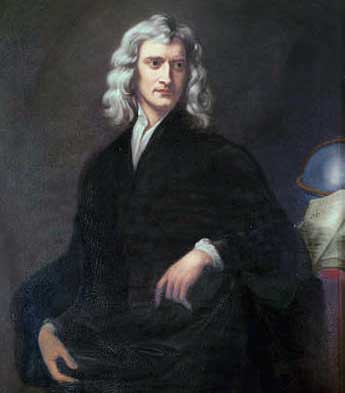
Intelligent Design (I.D.) and Isaac Newton

Isaac Newton and Intelligent Design

Isaac Newton wrote that he believed God occasionally intervened miraculously to set the planets right in their orbits, i.e., to correct cases of minor perturbations.

Apparently Newton was aware that sometimes two or more planets might be circling the sun and pass relatively near each other, influencing each other gravitationally, pulling each otherʼs 3-D orbits out of whack slightly, and that could add up over time. So Newton pictured God as intervening from time to time to keep his perfect celestial clock running smoothly, correcting such minor perturbations.

Today, astronomers no longer invoke “God” to restore orbital perturbations. Neither do they invoke “God” to explain how all the elements continue to rise out of fusing simple hydrogen atoms (a reaction that occurs inside stars via fusion, with the heaviest elements being created during novas).

In fact, todayʼs astronomers speak in terms of a messy astronomical past filled with orbital perturbations, and also speak in terms of a treacherous future filled with bleak possibilities for our planet and/or solar system:

Articles from New Scientist

“Birth of the planets: The Earth and its fellow planets may be survivors from a time when planets ricocheted around the Sun like ball bearings on a pinball table” 24 August 1991 issue 1783

“Jupiter drifted towards sun in its youth” The giant planet drifted tens of millions of kilometers towards the sun in its youth, a new study suggests, perhaps even helping to form the Earth. 26 September 2004

“Wandering Jupiter took trek towards the sun” 25 September 2004

“Planet formation is violent, slow and messy” A new view of planet formation is revealed by observations of nearby stars - it suggests Earth-like planets might be common. 19 October 2004

Did a planetary wobble kill the dinosaurs?”… A wobble in Mercuryʼs orbit could have wiped out the dinosaurs…to see when the next potentially catastrophic planetary wobble will be…

“New moons suggest brutal beginnings” Five new moons circling Neptune, and two tiny moons newly discovered around Saturn hint at violent pasts 18 August 2004

Or a nearby star could go nova, or simply pass near our sun. Also, thereʼs the fact that hundreds of asteroids cross the earthʼs orbital path each year.

So we live with far more uncertainty than Newton did. Even our genes apparently have undergone loads of perturbations due to mutation-facilitating ALU sequences, according to this weekʼs news. (“Scientists track ‘stealth’ DNA elements in primate evolution” 02 May 2005)

Not to mention living with the knowledge of other kinds of perturbations, like several major (and many minor) periods of extinction in the past.

Not to mention the fact that a third to a half of all fertilized human eggs simply donʼt survive. Even of those humans who get to emerge living from the womb, half of them used to die by age seven (according to Buffon, writing 200+ years ago).

In nature some species lay several thousand eggs, that vast majority of which donʼt survive. Plant seeds face a similar rate of death. Some bacteria divide so fast that they could fill the oceans and land in a few days, but their death rate is likewise enormous.

My observation is simply that given all we know, above, natural selection is an obvious hypothesis. Each organism is tested by nature beginning with pre- fertilization “sperm wars,” then during the zygote and early embryogenesis stages when a third to a half of them all donʼt survive, and thereʼs the missing twin syndrome later on in pregnancy, a quite common failing, such that perhaps 30% of all single births were once twins in the womb, and then after birth during childhood more testing from mother nature takes place with a large childhood mortality rate (which if you survive that test, your odds of surviving to old age are greatly enhanced), all the way up to adolescence when human beings begin another breeding cycle, and then social and sexual selection plays a further testing role. Such a rigorous testing plan occurs throughout nature for every individual of every species. Thatʼs how natureʼs perturbations are dealt with—not by “god” stepping in miraculously to “correct” things. If that is not “selection” of some sort then what is it?

And if this process selects out the deleterious mutations, then doesnʼt that also mean that it also “selects-in” the beneficial mutations that make a healthy life and sexual reproduction more likely next time? (Just think of it this way—When a Christian sport-person crosses themselves and prays silently that their side “scores a touchdown,” or “makes a basket,” or “gets a hit” and “wins,” then arenʼt they also praying that the other side loses? Such things work both ways.)

Just a thought.

What is Intelligent Design?

January 28, 2005, Sharon wrote: I really donʼt understand what Intelligent Design is all about — or the arguments against it. Itʼs a mish mosh of techno babblings that goes in one ear out the other and right over my head.
I guess you need a firm grasp on biology and astronomy to *get it* because I donʼt.
You ought to write an article “What is Intelligent Design?” and covering the basics for amateurs like me. Baby stuff — you crawl, then walk, then run. Try “I.D. for Dummies”.
From my understanding it boils down to: “I.D. is based on the belief life is too complex to have simply formed on its own, therefore God did it.” (And of course the Christian God is credited.)

I have a real problem with that. Go back 3.8 billion years ago, approximate date of the oldest known fossil material — and go back earlier in time when life began evolving. Who says that life came about *poof* overnight when complex organisms like Humans themselves are a product of less-complex life, one-celled organisms — spanning four billion years of evolution? [Human Evolution, Mother Of Man - 3.2 Million Years] The origins of life itself could have evolved over time. DNA could have evolved from something less complex. Humans didnʼt pop into existence, [our first ancestors only came on the scene around four million years ago]. If humans didnʼt, why should DNA? Just because it seems complicated today after four billion years of evolution does not mean it was so four billion years ago.

What is Intelligent Design?

Edward Babinski It only takes 9 months for a human to arise from a single cell, yet creationists are absolutely certain that given a couple billion years, and even the directing hand of God (as in theistic evolution), a single-cell could never become a human being, and upright large-brained apes could never become human beings.

Thatʼs because they would never dare doubt the words of a pre-scientific scribe, as they literally understand them.

I really donʼt understand how “Well, itʼs too complicated to understand therefore God did it.” And to me, physics is complex, astronomy and genetic engineering — those subjects are way beyond my grasp — but if I were to study them, Iʼm sure I would learn quite a number of things. How long ago was DNA discovered? In the 1940s or 1950s? [ see footnote #1 ]
Creationists have barely given science the time to even crack the human gene and jumping the gun saying “Itʼs too complex.” Given another 75 years or so, itʼll probably become common knowledge how DNA works — and perhaps something more on its origins and perhaps even the big question: Abiogenesis, the origins of life itself.

I think Intelligent Design is summed up as: “Impatience on behalf of Creationists”.

Edward Babinski Youʼre right on target, sounds like “impatience” to me too.

But then, many creationists are impatient for everything to over, the whole shebang, rapture, Armageddon, etc. *sigh*

Perhaps you have a better definition than mine?
I mean isnʼt “Itʼs too complex to understand, therefore a supernatural being did it”… the basis for all superstition? and superstition does not belong in the classrooms of the public school system.
Speaking from personal experience, what I see happening with such a hypothesis built on superstitious belief “itʼs too complex to understand, therefore a spirit did it”, is telling children, itʼs a waste of time to study deeper into the origins of life… pack up your books, you wonʼt need them — forget that chemistry or biology degree — itʼs a closed case. Thus, a student that would have potentially became another Francis Crick or James Watson to advance the understanding of DNA and origins of life — well, they decide to become an engineer in an unrelated field that avails opportunities to exercise their critical thinking skills.
Itʼs the same old song from the Dark Ages. “Itʼs too complex, therefore why waste time studying it? The Bible has laid it all for mankind in black and white… the greatest mystery of all! Read! Learn.”

How many centuries will that book hamper scientific progress and enlightened thought?
Whatʼs ironic about the whole thing is that they say “Itʼs too complex to understand therefore it cannot be explained.” Theyʼre really ones to talk, when it comes down to their Bible. How many denominations have sprouted from one Christianity due to differences on interpreting one little book?
Thatʼs chaos… Thatʼs confusion that will never be understood. One little book. Yet, all of them believe they hold the monopoly on the one and only truth, and everyone else is wrong. Since the Bible cannot be explained, perhaps we should just throw in the towel and hang it up — abandon the Bible —and never waste our time reading the Bible again. After all, itʼs “supernatural” in origins, and therefore impossible to understand or decipher. Theyʼve been trying for two thousand years, and havenʼt gotten any closer to a coherent interpretation than the early fathers of the Church. Give up and not even try to investigate and superstition rule the day. Thatʼs what Creationists would like science to do in its pursuit of exploring the origins of life.

Hypothetically speaking:
The Bible itself states that God is not the author of confusion.
(Too complex to understand?)
1Cor:14:33: For God is not the author of confusion…
Logically speaking, since the New Testament God is a God of orderly reason, then it should be safe to conclude the discovery of how the origins of life came about, are right around the corner. Surely the good Lord used a scientific process that can be replicated in a lab, and in time, scientists will stumble upon it. [/sarcasm]
I really donʼt understand where theyʼre coming from in their reasoning. “The origins of life is too complex to understand therefore we need the Bible to unravel it.” God is in the chaos and confusion of life origins? Then God is also in the chaos and confusion of car wrecks where people are ripped mercilessly apart by natural forces. God is in the chaos and confusion of dangerous animals and deadly microorganisms which mankind has been plagued with for millions of years and tends with daily. God was in the Anthrax that circulated around 9/11. God is in the chaotic confusion of deadly weather formations like Tornadoes, Hurricanes, Avalanches and Blizzards and God can be found in the meaningless confusion of deadly geological events like Tsunamis, Volcanoes, Floods and Earthquakes. I suppose those too are “too complex to explain”, well, primitive and superstitious savages might would think so. Actually a good meteorologist or seismologist can explain those “awe-striking events” quite well and without need to mention a god. (And, need I add that despite the passing of decades and centuries of studying, these scientists are still making efforts to refine their techniques to predict catastrophic geological and atmospheric conditions, to save human lives.) Unlike Religion, Science is never a “done deal”, and certainly never “perfect”… though far less frequently “false” in what it asserts.
The way I see it, itʼs only one more historical hurdle for science. Intelligent Design seems to me like Superstitionʼs last ditch effort to drag scientific progress backward. But if thereʼs one thing human history has proven that is that Science will go forward.

I think you understand I.D. just fine. *smile* They try to win over the crowd with improbability calculations, but such calculations do not take into account the fact that nothing is inherently probable, since you have to do the hard work of studying what life does, how it moves and lives and how it develops and changes from the tiniest scale to the largest scale, even the social scale. And that takes increasingly detailed knowledge about molecules and life in their living matrix, something the I.D.ists have no time for, since they have one answer and one answer alone to all such questions:

“You Need Lots of Dees Here Molecules Working Togeder To Make Dings Work, Lots of ʻUm Molecules, Yup, One Dare, and Anuder One Dare, And, Anuder Over Dare, and Some Down Dare, And, Oh Heck, Just Say Da Designer Did ID. Class Dismissed!”

Footnote #1
Englishman Francis Crick, American James Watson with the help of two English scientists, Rosalind Franklin and Maurice Wilkins discovered DNA through x-ray diffraction in the year 1953. In 1961, Drs. Watson, Crick and Wilkins won the Nobel Prize in Medicine. Dr. Franklin died before she received the famous award.
Source: My Name is Gene, N.L. Eskeland, Ph.D and N.C. Bailey, Ph.D
Return to Top

Conversation with William Dembski on Intelligent Design

William Dembski

On November 14, 2003 Ed Babinski wrote:
Subject: EVO-DEVO, Dr. Gilbert, “Teaching Evolution Through Development”

Edward: Thanks very much Dr. Gilbert. Your online lecture raises intriguing points, and it was very recently posted, so it is “news” worth sharing, especially the many examples you provide of organisms that share the same basic developmental genes and how those genes have kept getting reused and changed only slightly in each case. Hence, not a lot of “mutation” is required to produce large scale changes, even to turn feathers to scales, as you point out below. And eyes need not have evolved over 40 times separately, since the same hox gene that induces eye formation is found in those species. Ultimately such studies might also unveil how little had to be changed in the genes of early primates in order to produce man. Or, as you state in the conclusion of your lecture:

“Many critics pointed out that population genetics cannot directly explain macroevolution. But when you add developmental genetics to the theory, you have a wonderfully robust mix that can explain evolution both within species and in higher taxa. It turns out that we humans are closer to other animals than we thought, and that the mechanisms by which the living world is generated are highly conserved.”

“Scott Gilbert”: Dear Ed,
Thanks for your kind note. My lecture can be found online at Developmental Biology
[Scott Gilbertʼs lecture at the Society for Developmental Biology meeting, Madison, 2002, titled, “Teaching Evolution Through Development.” First posted: Nov 07, 2003]
I enjoyed your website on why we believe in a Designer. Years ago, when I told my wife about Intelligent Design, she laughed. She is an obstetrician/gynecologist. They donʼt particularly believe in the “perfection” of design.

[Edʼs comment: I know of one female creationist with an anthropology degree, so Iʼm sure there are female I.D.ists with advanced degrees. But the exact meaning of “perfection” in any particular instance of nature remains elusive because invoking the word, “perfection,” leaves you wondering, “perfect” compared with how many other possible designs?]

Best wishes!
Scott

On November 17, 2003, Edward Babinski wrote:
Subject: Re: EVO-DEVO, Dr. Gilbert, “Teaching Evolution Through Development”

Dear Dr. Dembski,

Wow! Thank you very much for your generous and timely response!

Just a few comments. I am unaware of any “state of crisis” as my I.D.ist friends claim exists. If there is any “state of crisis” isnʼt it on the side of those who claim that invisible entities are micro-managing nature over billions of years of death and suffering and extinctions? (Doesnʼt sound like a highly impressive “micro manager,” I mean, “perfecting” so many species only for them to become extinct over and over again.)

Hereʼs a question I have, based on three examples from nature:

  1. The Bedbug—The male bedbug has a penis that penetrates the females abdomen in a traumatic act, but hereʼs the point I want to raise, only a single species of bedbug is known to have evolved to the point that males of that species penetrate the abdomens of other males while the first male is inseminating a female.
  2. The Bombardier beetle—Only one species of “bombardier” beetle has a moving turret to direct its spray, the rest can only spray in one direction, usually covering their own backs, and other species of beetles have similar overall anatomies but without spraying anything.
  3. Home Sapiens Sapiens—There is only one surviving species of human being but many primitive extinct primates, and loads of extinct hominid species. Based on such examples, my question is why does specialization in the cases I have cited, always leave behind so MANY less highly “specialized” species for the very few highly specialized species? If a Designer is micromanaging the specialization, then why leave the majority of creatures “behind” as it were? Isnʼt that more a prediction of evolution than “design?” To put it other ways: Why should a Designer require two to three billion years to move from the earliest known single-celled creature to the first multi-cellular creatures? Why does a Designer require six million years to produce human beings and also have to leave behind so many extinct primate species and then extinct hominid species in the process?

And what do you believe is left of the truth of Genesis according to your I.D. view? Is there a definitive I.D. commentary on Genesis? Why not? Are Godʼs words less sure of interpretation than science is? I mean I.D. says it knows “the” truth about science, but it canʼt agree on an interpretation of Genesis even though “Scripture is given of God and not of private interpretation,” and, “the Holy Spirit will lead you into all truth?” Well, whereʼs the “truth” in Genesis that all the theists can plainly read? If it is just some general truth that canʼt even distinguish between helio or geo-centrism (there are geocentrist creationist Bible believers who can point to verses that certainly seem to me to assume a geocentric cosmos). Or if God canʼt even speak so plain as to tell us if creation is thousands or billions of years old. Or if God canʼt speak so plainly as to tell us whether various species popped into existence instantaneously, or whether they came from each otherʼs wombs after individual micro-mutations, then Iʼd say there is nothing much that Genesis can honestly tell us, no more than any other ancient creation account found in any other religion, and therefore, Biblical interpretation is “in a state of crisis,” not science.

On November 17, 2003, Edward Babinski wrote:
Subject: Re: EVO-DEVO, Dr. Gilbert, “Teaching Evolution Through Development”

“William A. Dembski” writes:
Comments interspersed.

Edward: Mine also. *smile* Thanks again for maintaining the correspondence. I am supposing that is Paulʼs email address above? I hadnʼt spoken with him in months, though we used to speak quite regularly for weeks on end, neither were there any hard feelings between either of us. He even published something I wrote at the ARN site, a small edited portion of something I wrote. Paul and I simply lost touch at one point. You can ask him about it and what we discussed. (My further responses appear interspersed below.)

11/17/2003, Edward Babinski wrote:
Dear Dr. Dembski,
Wow! Thank you very much for your generous and timely response!
Just a few comments. I am unaware of any “state of crisis” as my I.D.ist friends claim exists. If there is any “state of crisis” isnʼt it on the side of those who claim that invisible entities are micro-managing nature over billions of years of death and suffering and extinctions? (Doesnʼt sound like a highly impressive “micro manager,” I mean, “perfecting” so many species only for them to become extinct over and over again.)
One thing at a time. You sent me something about evo-devo, claiming that it closes the macroevolutionary gap. It doesnʼt.

Edward: Pardon, but it does close various evolutionary gaps. Instead of the genes that induce eyes having to evolve entirely separately 40 different times we have the same gene that induces eye development (conserved in all of those species, which evolutionists assume are descended from a common ancestor), and able to induce eye development in all of those species. So instead of many genes, a few hox-like genes are found to be major directors that facilitate some relatively broad changes like fins to feet, scales to feathers, and, they even decide whether there is no invagination of the skin and forming of an eye cup—or—the skin invaginates and forms an eye cup in the head region. In fact, that is exactly the sort of evidence that evolutionary geneticists have been seeking right along, ways to consolidate various major changes in broad ranges of diverse species via fewer shared genes and fewer genetic mutations.

Conversely, keep in mind that there is no “gap” at all in I.D., since miracles—from the tiniest micromutations to the instantaneous creation of whole new organisms and their habitats—explain both anything and everything.
*smile*

Whatʼs more, just because you and Scott donʼt recognize the crisis doesnʼt mean there isnʼt one. I expect that those who knew the Titanic was unsinkable were convinced there was no crisis until they actually saw the ship going down. Of course, the actual crisis ensued once the Titanic hit the iceberg.

Edward: Whose ship is taking on water is a moot point between us, so why waste your breath on a wry “Titanic” analogy more suitable for the pulpit than a scientific discussion?
One quotation that I ran across on my own is this one: “[Richard] Owen [the famed anatomist] says my book will be forgotten in ten years, perhaps so; but, with such a [short but prestigious] list [of scientific supporters], I feel convinced that the subject will not.” [Darwin in a letter to J. D. Hooker, 3/3/1860].

Speaking of my own view, I think the “fine-tuning hypothesis” raises more challenging questions than the “I.D. hypothesis.” See for instance:

The “Fine Tuners” Challenge the “Intelligent Design” Movement Fine Tuners acknowledge that accident may not be the best way to explain the whole cosmos. They also find that the Intelligent Design movement embraces faulty simplistic arguments and proofs.
The Fine-Tuning Hypothesis, an alternative to the Intelligent Design Hypothesis

As for God micromanaging nature, thatʼs a convenient caricature.
Precisely because God allows a world to unfold in freedom,

Edward: “Unfold in freedom” is an intriguing phrase. Please explain what kind of changes organisms “free” to engage in, and on what biological levels if you can say. Surely there are Christians like Miller and Denis Lameroux (sp?) who are biologists who can use the same phrase you do to express their belief that natural selection allows nature to “unfold in freedom.”

no micromanaging is required

Edward: Please elucidate. Are you saying that you believe that the very first cell was pre-programmed to “unfold” on its own into all subsequent life on earth? That there was no miraculous genetic tinkering, nothing being added or subtracted (in micro-managerial fashion) at later geological periods? If that is what you are saying, please let me know, and we could discuss that particular hypothesis. I believe Behe suggested that idea off the cuff in his first book, but now has doubts concerning it. I mean, just how much genetic information would the very first cell have to have? The earliest known organisms in the fossil record were merely bacteria! Tiny things, with tiny nucleusʼ compared with the Eukaryotes that appeared later. So it canʼt be a case of a bacterium with a nucleus that is many times the cellʼs bacterial-size, a nucleus that is merely whittled down over the geological eons, the has to keep splitting off to form hundreds of millions of unique species that must have existed over the eons. The “whittling down of a super nucleus” hypothesis appears dead in the water. But then we are left with a hypothesis in which we both agree, namely that a simple cell, as simple as a bacterium can evolve into super sized Eukarotes and billions of diverse species each with their own unique habitats and behaviors. And that would certainly imply evolution in my book, rather than I.D. So if you are trying to reduce the I.D. question down to the question of merely “abiogenesis,” and the “first cell,” you certainly appear to be more evolutionist than anything else. Especially since that would make Darwin and I.D.ist by such a definition! Just read the last paragraph of The Origin.

and a history of death, suffering, and extinction becomes compatible with a world that exhibits design (which is not to say that every aspect is designed). You seem wedded to a naive theology and stuck on the theodicy problem.

Edward: As I pointed out above, there are no “gaps” when miracles are invoked to explain things, even death, suffering, extinction, are all explainable, as are things that you say were “not designed,” though could you please give me a list of things in nature that are “not designed” so I can ascertain exactly what you mean by that phrase, and compare it with a list of things in nature that you are sure are “designed?”

Hereʼs a question I have, based on three examples from nature:
  1. The Bedbug—The male bedbug has a penis that penetrates the females abdomen in a traumatic act, but hereʼs the point I want to raise, only a single species of bedbug is known to have evolved to the point that males of that species penetrate the abdomens of other males while the first male is inseminating a female.
  2. The Bombardier Beetle—Only one species of “bombardier” beetle has a moving turret to direct its spray, the rest can only spray in one direction, usually covering their own backs, and other species of beetles have similar overall anatomies but without spraying anything.
  3. Homo Sapiens Sapiens—There is only one surviving species of human being but many primitive extinct primates, and loads of extinct hominid species. Based on such examples, my question is why does specialization in the cases I have cited, always leave behind so many less highly “specialized” species for the very few highly specialized species? If a Designer is micromanaging the specialization, then why leave the majority of creatures “behind” as it were? Isnʼt that more a prediction of evolution than “design?” To put it other ways: Why should a Designer require two to three billion years to move from the earliest known single-celled creature to the first multi-cellular creatures? Why does a Designer require six million years to produce human beings and also have to leave behind so many extinct primate species and then extinct hominid species in the process?
See last point. The theodicy question is separate from the design question, and you donʼt resolve the design question by saying that any putative designer wouldnʼt have done it that way. Now if you want to talk theodicy, Iʼm happy to do so, but again, thatʼs not why you wrote me and thatʼs not what the chapter draft I sent you was about.

Edward: You misunderstood my question. It was not a question of “Theodicy,” it was a question of probabilities. Evolution predicts that specialization is a process over time, and that not all organisms achieve it, in fact it predicts that few achieve it, just as in the case of bacteria that develop resistance to antibiotics or insects that develop resistance to pesticides, only a few mutate to the point of specialization that allows them to adapt and survive in large numbers in such an environment, while the majority of organisms do not specialize as rapidly or as completely, and die out. As I said, only a single known species of bed bug rapes other males, and, only a single known species of the suborder of beetles known as Adephaga, has a movable turret to point the chemicals that shoot out of it, and, only a single know species of primate, and then only a single known species of hominid, evolved into homo sapiens. That is what evolution predicts, it certainly fits evolution. But according to I.D. the possible scenarios for “designing” the living world seem endless instead of this whittling down process that the geological records actually reveals.

Take birds. They are preceded by feathered dinosaurs. And then by feathered gliding dinosaurs with long boney tails that create drag, heavier skeletons, reptilian-shaped triangular skulls, teeth and non-hollow bones that added weight, small keel bones instead of the massive keel bones found in modern birds that attach the flight muscles. In short, the early birds are clearly not as designed for flight, nor as highly specialized for it as modern species are. In fact only one species of bird can fly backwards, the hummingbird, a late arrival on the geological scene. Again, such a progression is one that evolution predicts, it fits evolution.

Take cetaceans, early whales were clearly not as highly specialized as modern day species. Early whales displayed earbones only partially-specialized for under water hearing. Early whales had nares at the tips of their snouts or later in the middle of their snouts, the nares didnʼt reach the top of their heads until later. Early cetaceans (whales, dolphins, porpoises) apparently shared the same ancestors, because the fossil record shows relatively smaller cetaceans early on, and only later did some species advance in size until we see the modern day Blue Whale as the largest organism ever to live on the planet (with the possible exception of some dinosaurian gigantosaurus). Neither did early cetaceans (whales, dolphins, porpoises) have the sonar apparatus found in most modern day species. Again, such a progression is one that evolution predicts, and which was borne out by the findings of paleontology.

As I said, yes, it is possible that I.D. or any hypothesis that invokes miracles could also explain such evidence—i.e., From non-specialized to highly specialized—From the many unspecialized to the few highly specialized—in order in the fossil record. But evolution is a more constrained and demanding hypothesis. So it seems that I.D. is going along with this evidence simply because it must, not because I.D. predicted it. (I.D. or some other varieties of miraculous explanations could have predicted things a zillion other ways.)

And what do you believe is left of the truth of Genesis according to your I.D. view? Is there a definitive I.D. commentary on Genesis? Why not? Are Godʼs words less sure of interpretation than science is? I mean I.D. says it knows “the” truth about science, but it canʼt agree on an interpretation of Genesis even though “Scripture is given of God and not of private interpretation,” and, “the Holy Spirit will lead you into all truth?” Well, whereʼs the “truth” in Genesis that all the theists can plainly read? If it is just some general truth that canʼt even distinguish between helio or geo-centrism (there are geocentrist creationist Bible believers who can point to verses that certainly seem to me to assume a geocentric cosmos). Or if God canʼt even speak so plain as to tell us if creation is thousands or billions of years old. Or if God canʼt speak so plainly as to tell us whether various species popped into existence instantaneously, or whether they came from each otherʼs wombs after individual micro-mutations, then Iʼd say there is nothing much that Genesis can honestly tell us, no more than any other ancient creation account found in any other religion, and therefore, Biblical interpretation is “in a state of crisis,” not science.
You seem bitter about your YEC experience.

Edward: You ignore the question of Biblical interpretation that I raised, above, and you ignore questions concerning which of various hypothesis is more obviously in “a state of crisis?” (your phrase, not mine). Sidestepping such questions with a question concerning oneʼs psychology? Isnʼt that nearer to being a preacherʼs tool than a scientific or mathematical argument? I find that people who use the “bitterness” argument are arguing _ad “bitter” hominem_ if I may coin a phrase. In my eyes I have been reasonable throughout my intellectual journey, as I am willing to grant that your journey also appears so in your eyes. (But if you wish people to respond for you tit for tat, then I might have written that you seem “bitter” about evolution, describing it as the “sinking of the Titanic” and “in a state of crisis.” *smile*)

I suppose thatʼs understandable.

Edward: As is your psyche to me. *smile*

And perhaps your skeptic friends are providing you with the intellectual enrichment that you didnʼt find as a YEcreationist. But given your undue preoccupation with your YEC past, it seems you havenʼt fully resolved this aspect of your life (perhaps Leaving the Fold is helping in this regard). Iʼm planning a book on Genesis, Creation, and Theodicy in which I have some new angles on how suffering that results from an evolutionary history could in turn be the result of a space-time fall of humanity (the key is appealing to Newcombʼs paradox).

Edward: More ad hoc explanations simply to try and reconcile the Bible and Science? How exactly is your ad hoc hypothesis going to differ from Humphries latest YEC ad hoc hypothesis that maybe the earth was at the center of a white hole at creation and the cosmos as well as time and space itself got stretched out in “days,” thus leading to the mere “appearance” of an “old” cosmos stretched out in billions of “light-years?” Humphries “white hole” hypothesis is typically worthless, even moreso than the famed creationist and I.D. rebuffs of “natural selection” being a pure tautology. What could be more purely tautological than arguments like Humphries or like the one you are currently devising above?

On the other hand, I suppose thatʼs how theology “works.” I mean if the act of one man suffering the pain of nails being driven through his palms two thousand years ago, can make another man living today a “saint” in Godʼs eyes (after death), THEN, “Adam and Eve” eating a bit of fruit can be cited as the reason why millions of species suffered for millions of years before Adam and Eve popped out of an Australopithecusʼs womb. (Speaking of Adam and Eve, I saw a book recently here in the college library where I work which stated that geneticists have discovered a genetic basis for “Adam,” a genetic-bottleneck back in time, a single individual or very small group of related individuals, from whom all of the genes of our species is descend, as well as having already discovered a genetic basis for something close to “Eve” though not a single individual. One little problem, as mentioned in the book, is that thereʼs at least 30,000 years worth of generations of descendants between the genetic “Adam” and the genetic “Eve.”)

Christian theological explanations appear to be growing increasingly more weird as science progresses and theologians seek to accommodate both the notion of some “history” in Genesis and the evidence coming to light from science. (But so far the explanations Iʼve read do not appear as weird to me as the fact that there isnʼt a verse in the Bible that isnʼt compatible with the ancient flat earth view that was prominent in the ancient Near East when both Testaments were written. All attempts to make the Bible sound “scientific” regarding modern cosmology are ad hoc, and based on ignoring the fact that historically speaking there is no necessity to even attempt to make the Bible sound scientific. Come on a talking snake that was “wiser than all the creatures of the field that the Lord had made?” “Fruit of a tree of eternal life,” just one bite and you lived forever? How literally is anyone supposed to take such stories? Creatures formed directly from the dust of the earth, and to that dust they shall return?)

There is nothing even remotely requiring a “scientific” explanation in the Genesis account of creation. Here are some excerpts from a new work, that like you, I am in process of composing:

Did God “gab” the world into being? Did His glossolalia fill the void? Or might not creation by the “word” of God be merely a poetic description of how God “called” the cosmos into being? But if one can accept that the description of God “speaking,” and the record of His alleged “words” is poetry, then what does that suggest about how the rest of the creation account in Genesis should be viewed?
- E.T.B.


The Book of Exodus in the Bible states:

In six days the Lord made heaven and earth, and on the seventh day he rested, and was refreshed.
- Exodus 31:17

According to learned editors of a Bible published in 1774, the true meaning of the Hebrew is, “on the seventh day He rested, and fetched his breath.” So, God is depicted as panting after over-exerting Himself? What a pretty piece of anthropomorphism.
- E.T.B.


In the Beginning there was Earth, Wind, and Fire?

All ancient “recipes for creation” begin with a few simple ingredients like “earth, wind, fire/light, darkness/night, and water.” According to ancient Egyptian tales of creation, nothing existed in the beginning except a waste of “waters,” also known as “the deep.” Greek tales speak of “earth, murky night, briny deep.” Babylonian tales speak of “waters.” One Sumerian tale spoke not of water, but of another basic ingredient, a mountain of “earth” that existed in the beginning. Phoenician/Canaanite tales speak of “the beginning of all things” as “a windy air and a black chaos which embraced the air and generated a watery mixture, and from this sprang all the seed of creation.” The Hebrew tale in the book of Genesis has the “spirit of God” (the literal Hebrew word for “spirit” also meant “wind or breath”) moving on the surface of “waters” in “darkness,” with “light” and “earth” to follow.

Neither does it appear to be a mystery why the same simple ingredients would appear in so many ancient tales of creation. The pre-scientific authors of such tales imagined that “earth, wind, fire, and water” constituted the “elements” of creation.

Abracadabra: the magic of the creatorʼs “word”

Many ancient tales of creation, not just the Hebrew one, attributed supernatural power to a godʼs “word,” i.e., simply “say the magic word” and things instantly appear, disappear, or are transformed. According to the Egyptian Book of the Dead every act of creation represented a thought of Temu and its expression in “words.” A host of Egyptian creation myths agreed that the agency of creation was the godʼs “word.” The pre-Babylonian civilization of Sumeria believed that all things existed and were created by the “word” of Enki. In fact, they viewed the “word” of all their gods as a definite and real thing—a divine entity or agent. Even Sumerian personal names reflected their belief in the power of the “word,” including names like, “The word of the wise one is eternal,” “His word is true,” and, “The word which he spoke shakes the heavens.” After the Sumerians came the Babylonians and their creation tale, Enuma Elish (nicknamed by scholars, the “Babylonian Genesis”), which began, “When Heaven had not been named, Firm ground had not been called by name… when no name had been named.” The Hebrew tale arose out of that same milieu.

Added to the ancient belief in the “magic” of “naming” things, was also the belief that the “word” of a ruler or king must be obeyed, and the gods were believed to rule over nature much like kings were believed to rule over their fellow men, i.e., by “divine right.” Therefore, whatever a god said, was “done” in nature. A fragment from Sumeria states, “Thy word upon the sea has been projected and returns not [void].” The Babylonian Enuma Elish, states, “May I [Lord Marduk, the Babylonian creator], through the utterance of my mouth determine the destines…Whatever I create shall remain unaltered, The command of my lips shall not return [void], it shall not be changed.” Compare the Hebrew usage of the same phrase in Isaiah 55:11, “So shall my [the Lordʼs] word be which goeth up from my mouth; it shall not return unto me void, For it shall have done that which I desired.”

Divide The Ingredients In Two

It was a common feature of early Greek cosmological beliefs, which they shared with those of the Near East and elsewhere, that in the beginning all was fused together in an undifferentiated mass. The initial act in the making of the world, whether accomplished by the fiat of a creator or by other means, was a separation or division. As the Hebrew myth has it, “God divided the light from the darkness…and divided the waters which were under the firmament from the waters which were above the firmament.”
— W. K. C. Guthrie, A History of Greek Philosophy, Vol. I, (Cambridge Univ. Press: 1962)

Ancient tales of creation often involved a division of primeval stuff into two equal halves—like cracking a cosmic egg in two and making “heaven” out of the top half and “earth” out of the bottom half. A Sumerian tale of creation has heaven and earth arise from a celestial mountain split in two. In Egyptian tales a god and goddess are pulled apart: “Shu, the uplifter, raised Nut (a water goddess) on high. She formed the firmament, which is arched over Seb, the god of the earth, who lies prostrate beneath her…In the darkness are beheld the stars which sparkle upon Nutʼs body.” The Egyptians also employed the less mythologized concept of a celestial dome (above which lies “the heavenly ocean”). In the Babylonian Enuma Elish, a water goddess is split in two by the creator to form upper and lower bodies of water, the upper half also becoming a “heavenly dome” that held back vast celestial waters. The Hebrew tale in Genesis has the creator make “a firmament in the midst [middle] of the waters, that it may divide…the water which was below the firmament from the water which was above the firmament.” Both the Babylonian and Hebrew tales continue with the “earth” being created in the lower half of the recently divided waters.

It is interesting to note that the Father of Protestantism, Martin Luther, was adamant that the Bible spoke of waters lying above the moon, the sun, and the stars. He countered the views of astronomers of his day with the words of Scripture:

Scripture simply says that the moon, the sun, and the stars were placed in the firmament of heaven, below and above which heaven are the waters…We Christians must be different from the philosophers [astronomers] in the way we think about the causes of things. And if some are beyond our comprehension like those before us concerning the waters above the heavens, we must believe them rather than wickedly deny them or presumptuously interpret them in conformity; with our understanding.
- Martin Luther, Lectures on Genesis, Vol. 1, Lutherʼs Works, Concordia Pub. House, 1958

A Hebrew psalm also acknowledged the existence of “waters above the sun, moon, and stars”:

Praise Him, sun and moon; Praise Him stars of light! Praise Him highest heavens, and the waters that are above the heavens!
- Psalm 148:3-4

And when the book of Genesis described a “flood” that covered the whole world, and reduced the world to its pre-creation watery beginning, the story states that the “flood gates of the sky” were “opened.” Neither did the author of that fable suppose that all the water above the firmament fell to earth, but that the “flood gates” had to be “shut” to stop more water from falling, and the creator had to promise not to flood the earth again with such waters. So, the Bible agrees with Luther that “the waters above the firmament” remained “up there”—and this agrees completely with ancient tales of creation in which the world arose from a division of waters which encompass creation still, and which the creator keeps at bay, having prepared a place in the “midst of such waters” for the earth.

Make Do With Whatʼs at Hand

Ancient creation accounts never explain where the first “waters,” or “earth,” or “darkness,” came from. Nor do the various creators make everything “out of nothing.” They often have to resort to creating plants, animals and human beings out of the earth or from parts of divine beings. Sometimes this includes molding creatures like a sculptor molds images out of clay—then imparting some magic to them. The Hebrew tale of creation in Genesis is no exception. It does not say where the water and the darkness came from “in the beginning.” Neither does it say that the “earth” was created out of nothing, but simply that “the dry land appeared” after the creator “gathered together the waters into one place.” Moreover, the Hebrew creator does not create vegetation and living creatures out of nothing but has “the earth” sprout vegetation, and “the earth” bring forth living creatures. The Hebrew creator also “formed man from the dust of the earth.” Then “blew into his nostrils the breath of life, and man became a living being,” kind of like blowing on a clay sculpture to magically bring it to life. Neither was the divine “breath of life” shared only with man, for the same phrase is used in regard to every living creature that the earth brought forth, “all in whose nostrils was the breath of life.” (Gen. 7:21,22)

In the Babylonian tale, Enuma Elish, the creator is called “the god of the good breath [of life],” and he creates man from something divine, the blood of a diety. (Sort of like the Hebrew tale where man is created in the “image” of the divine creator and brought to life by divine breath.) Alternate creation accounts from ancient Babylon have mankind springing up from the ground, or created from the flesh and blood of a god mixed with clay, or even fashioned by the chief Babylonian god with the help of a divine “potter”—not unlike the Genesis account of man being “formed [molded] from the dust of the ground.”

Things Were Created as they Appeared to the Ancient Mind

Another factor most ancient tales of creation share is that things are created as they appeared to the ancient mind. Plants and animals are described as having been created in the forms in which they appeared in the authorʼs own day. The earth appeared like the flat and firm foundation of creation, the sun and stars appeared to move across the sky on a daily basis, the sky appeared like a dome stretched over the earth with a blue color reminiscent of the oceanʼs waters below it, and the sky contained objects whose function appeared to be to “light the earth” below.

In a similar fashion, “days and nights” as measured on earth appeared central to earth-dwelling ancients like the Hebrews, who divided their tale of creation into six “days and nights” of earthly duration. While today, astronomers recognize the earth as one planet among many, each having “days and nights” of their own unique duration.

Moreover, every one of the “six days” of creation in the Hebrew tale is devoted to creating things for the earth alone. Even the “first day of creation” when the Hebrew creator instituted “day and night,” it was an earth-day and an earth-night which were instituted. And on the day when the Hebrew creator set lights in the firmament above the earth, they were created after the earth and “for” the earth—and a day after fruit trees! In fact the entire Hebrew tale supports the idea that naive earth-centered appearances dictated the tale from beginning to end.

Is any Inspiration Required to Account for Ancient Tales of Creation?

The level of inspiration required to explain the origin of naive and simplistic concepts like “earth, wind and fire,” “abracadabra,” “divide the ingredients in two,” “make do with whatʼs at hand,” and, “things created as they appeared”—is equal to the level of mental sophistication of a young child. In fact the Harvard Smithsonian Center for Astrophysics conducted a study during the 1980s on the mental sophistication of children and discovered that almost one-half of children aged ten years and younger in the United States and other countries believe the earth is flat. And those who say it is round picture “round” as a giant pancake or a curved sky covering a flat ground. One in four thirteen-year olds also believes the earth is flat.
- E.T.B.


“Evenings and Mornings” / “Days and Nights,” were Created Before the Sun?

Genesis tells us that the creator “divided the light from the darkness” and instituted “evenings and mornings.” But He did that “three days” before the “sun” was made! So the sun was kind of an afterthought, and alternating periods of light and darkness were Godʼs primary creations. The book of Job like the book of Genesis, agrees that “light and darkness” do not rely upon the sun, but have their own separate and distinct dwelling-places:

Where is the way where light dwelleth? and as for darkness, where is the place thereof?
- Job 38:19

Therefore the belief arose, especially among Christians, that the light of “day” had no relationship to the light of the sun. Indeed, in the fourth century, Saint Ambrose wrote in his work on creation:

We must remember that the light of day is one thing and the light of the sun, moon, and stars another—the sun by his rays appearing to add luster to the daylight. For before the sun rises the day dawns, but is not in full refulgence, for the sun adds still further to its splendor.
(Hexameron, Lib. 4, Cap. III).

Ambroseʼs teaching remained one of the “treasures of sacred knowledge committed to the Church” right up till the Middle Ages at which time Jews could still be tortured or condemned to death for disputing it! Like all dogmas it inspired subversive humor from those forced to assent to it:

“Which is more important, the sun or the moon?” a citizen of Chelm asked the rabbi (“Chelm” being a village of Jews who lived in the shadow of the Inquisition).

“What a silly question!” snapped the rabbi. “The moon, of course! It shines at night when we really need it. But who needs the sun to shine when it is already broad daylight?”
- E.T.B. (Joke drawn from Encyclopedia of Jewish Humor, Henry D. Spalding, Ed., New York: 1969)


According to the first chapter of Genesis, the earth was created before the sun, moon, and “the stars also” (notice how the “stars” were regarded as mere trifles, lumped together at the end of the inventory). This order of creation is absolutely farcical. Our earth is a child of the sun. The offspring could not have existed before the parent.

The sun, moon, and stars were “made and set” in heaven “to give light upon the earth?” When we look beyond our solar system into the mighty universe of other suns and planets, we see that the cosmogony of Genesis is a dream of childish ignorance. When the Greek philosopher Anaxagoras dared to suggest that the sun was as large as the southern part of Greece he startled his Greek contemporaries. What must have been the notions of a grossly unscientific people like the Jews? For them it was easy to regard the sun, moon, and “the stars also,” as mere satellites of the earth, “set” up in the sky as lanterns for the human race.
- George William Foote, “The Creation Story,” Bible Romances


If the sun, moon, and stars were created “to light the earth,” then why create 50,000,000,000 galaxies whose light is invisible to the naked eye? (The two nearby galaxies that can be seen with the naked eye appear no brighter than two dim stars in our sky.) In other words, 50,000,000,000 galaxies produce light that can only be seen with our most powerful telescopes, and it took a telescope mounted in space to detect 49/50ths of those galaxies! Moreover, each of those galaxies is composed of about 1,000,000,000 stars, some of which are far larger than our sun. God sure did go through a lot of trouble to not “light the earth” with those 50,000,000,000 galaxies, didnʼt He?

Recent astronomical evidence even supports the “dark” matter hypothesis, namely that most of the matter in the cosmos sheds little or no light at all.
- E.T.B.


My older brother Joshua had become “enlightened” at about the age of eighteen and began to argue religious problems with my parents. I heard him say, “All religions are based on old books, but these books were written by men and men can lie, distort the truth, or have illusions. If we Jews donʼt believe in the old books of other religions, how can we know for certain that our books contain the absolute truth?” My parents could never give him a clear answer. All they could do was scold him and call him heretic, betrayer of Israel.

Yes, I began to study the Book of Genesis both with faith and with doubts. In my mind I had formulated many questions for the scribe of this holy book: What did God create first, the earth or the water? Or was the water already there beforehand? When did He create the wind which swept over the waters? And did He also create “the waste and the void?” I had heard that the light of day came from the sun. But according to the Book of Genesis, God created the light first and then the sun.

The more I read, the more questions and doubts assailed me. If God could have created Adam by the words of His mouth, why did He have to cast a deep sleep upon Adam to form Eve from one of his ribs? I have always heard from my parents that God is a god of mercy. But why did He accept the sacrifices of Abel and not those of his brother Cain? Didnʼt He foresee that this would cause jealousy and enmity between the two brothers? And why did He create the serpent to lure Adam and Eve to sin? [“The serpent was more crafty than any beast of the field which the Lord God had made.”—Gen. 3:1]
- Isaac Bashevis Singer, “Genesis,” Congregation: Contemporary Writers Read the Jewish Bible, ed., David Rosenberg


To stretch the chronology of Genesis a bit, creationists are willing to admit there are mini-gaps in the genealogies of Genesis that total several thousand years. But why, if God directly inspired Moses to write those genealogies, should there be any gaps at all?
- A. J. Mattill, Jr., The Seven Mighty Blows to Traditional Beliefs (enlarged edition)


Why Does the Bible Fail to Mention that Creation was Never Really Finished?

According to the Bible, God made the stars on the fourth day of creation. Even more remarkable is the fact that He is creating them still, though the latter miracle is considered not worth mentioning by any of the Bibleʼs authors. (I wonder why? The creation of new stars is being chronicled continually in magazines and journals like Astronomy, Sky and Telescope and The Astrophysical Journal, just to name a few.)

And God is still creating new planets (that continue to form out of rings of matter circling stars—see the above mentioned magazines).

And God is still creating new elements out of simple hydrogen atoms inside stars where atoms continue to fuse and form elements with increasingly more protons and electrons (the heaviest known elements are created during super nova explosions of stars).

And God is still creating multi-cellular organisms out of single cells that keep dividing (embryogenesis).

And God is still transforming mere water and inorganic minerals into more and more living microorganisms that other organisms eat, thus keeping the food chain going, such that all life depends on the daily transformation of the simplest of molecules (water and inorganic minerals) into living microorganisms. So, if you include the “food chain” leading from the simplest organisms to man, God is still turning inorganic matter into human beings (and turning simple oxygen molecules into “the breath of life”).

Yet creationists argue that aside from the creation of new stars and new heavier elements inside those stars—aside from the turning of simple inorganic matter into an array of living organisms that keep increasing in number and branching off into new species—evolution is “prohibited by the second law of thermodynamics.” Iʼd say they are missing the forest for the trees which by the way, continue to grow from tiny seeds; trees that become forests which continue to reach out and envelop as much of the earth as they can, and whose members continue to branch off (forgive the pun) into new species as they do so.
- E.T.B.


Genesis 1:16 depicts the sun and moon as creationʼs “two great lamps,” made after the earth, to “light” it, “rule” its day and night, and, “for signs and seasons” on earth. But a couple thousand years after the Bible was written, astronomers discovered a curious thing. They discovered that Mars has two moons. Yet Mars has no people who need their steps “lit” at night, or who need to read the “signs and seasons.” Even more curiously, it was discovered that Neptune has four moons, Uranus has eleven, Jupiter has sixteen, and Saturn has eighteen moons (one of them, Titan, is even larger than the planet Mercury)! The earth was created with just one; and it “rules the night” so badly that for three nights out of every twenty-eight it abdicates its rule and doesnʼt light the earth at all, at which time we bump into folks in the dark.
- E.T.B.

You might find it interesting. For details, stay posted to my website http://www.designinference.com/
—WmAD